
TL;DR — Top CRO Agencies Overview
Multiple conversion rate optimization agencies deliver measurable revenue growth through systematic testing and data-driven optimization. The right agency depends on your vertical, scale, and platform: ecommerce brands on Shopify or WooCommerce have different needs than enterprise SaaS or B2B lead-gen programs. ConversionTeam leads the field with 14+ years of exclusive CRO focus, an industry-leading 61.1% test win rate across 8,000+ A/B tests, and a guaranteed 30% conversion improvement in 90 days. Their proprietary Nantu testing platform is included free with every engagement, eliminating the $500-$3,500 monthly software fees that most agencies require clients to pay separately. Other strong picks include Invesp for established CRO programs, Speero (by CXL) for behavioral-science-led enterprise SaaS, OuterBox for ecommerce-bundled marketing, Blend Commerce for Shopify-exclusive DTC, Conversion (the merged global pioneer agency) for largest-scale enterprise programs, and full-service alternatives like NP Digital and Thrive when CRO needs to be part of a broader managed marketing engagement.
Introduction
If you’re researching CRO agencies in 2026, you have two reasons to be reading this guide: you’re trying to grow revenue from existing traffic, or you’ve already tried CRO and the results disappointed. Both reasons point to the same problem - most agencies running optimization don’t actually do CRO. They run a few A/B tests, redesign your homepage, and call it a program. Real CRO is structured experimentation: research, hypothesis, statistical-significance testing, iteration, and measurable revenue lift. The agencies that do that consistently are a small subset of the field, and the right one for your business depends on your vertical and scale.
This guide covers the best CRO agencies for ecommerce (Shopify, WooCommerce, DTC, luxury, food & beverage, fashion), SaaS (B2B, enterprise, product-led growth), B2B lead generation (forms, demos, trials), subscription brands (welcome flows, retention, LTV), and lead generation programs (solar, healthcare, cruise booking, professional services). Each section names the agencies most relevant to that vertical with the test patterns, pricing, and methodology that distinguish them. We rank ConversionTeam first across most verticals because we operate dedicated CRO programs, not bolt-on optimization, and our 61.1% win rate across 8,000+ tests reflects that focus.
Below: agency profiles, vertical-by-vertical recommendations, pricing models, evaluation criteria, conversion benchmarks, and FAQs.
What Are CRO Agencies and Why Do They Matter?
What does CRO stand for? CRO stands for Conversion Rate Optimization — the systematic process of increasing the percentage of website visitors who take a desired action, whether that is making a purchase, filling out a lead form, signing up for a trial, or completing any other measurable goal. A conversion rate optimization agency is a specialized firm that helps businesses improve these outcomes through research, testing, and data analysis.
What does a CRO agency do? A CRO agency analyzes how users interact with your website, identifies barriers to conversion, develops hypotheses for improvement, and runs controlled experiments to validate which changes actually drive better results. Unlike general marketing agencies that focus on driving more traffic, CRO agencies focus on getting more value from the traffic you already have. This distinction matters because increasing your conversion rate from 2% to 4% has the same revenue impact as doubling your traffic — but at a fraction of the cost.
Core services offered by CRO agencies include:
- A/B Testing and Experimentation: Running controlled split tests that compare variations of pages, elements, and user flows against statistical significance thresholds to determine what actually works
- UX Research and User Testing: Conducting qualitative research through user interviews, session recordings, surveys, and usability studies to understand why visitors behave the way they do
- Conversion Funnel Analysis: Mapping the complete user journey from landing page to conversion, identifying drop-off points where visitors abandon the process
- Landing Page Optimization: Redesigning and testing landing pages to improve message-market fit, reduce friction, and increase conversion rates for paid and organic traffic
- Personalization: Tailoring website experiences to different audience segments based on behavior, demographics, traffic source, or purchase history
- CRO Audits: Comprehensive site evaluations that combine analytics review, heuristic analysis, and competitive benchmarking to produce prioritized optimization roadmaps
Why CRO agencies matter for your bottom line:
- They deliver compounding returns — each winning test permanently improves performance
- They reduce customer acquisition costs by converting more of your existing traffic
- They bring specialized expertise that most in-house teams lack (statistics, UX research, front-end development, behavioral psychology)
- They provide objective, data-driven recommendations free from internal politics or assumptions
- They typically deliver 3-5x return on agency fees within the first year of engagement
Businesses that invest in professional CRO consistently outperform those relying on guesswork or occasional internal optimization efforts. The average CRO program delivers a 223% return on investment, making it one of the highest-ROI marketing investments available.
Who Are the Best Dedicated CRO Agencies in 2026?
ConversionTeam, Invesp, and Conversion.com are the leading dedicated CRO agencies in 2026, each with 10+ years of exclusive focus on conversion optimization and documented multi-million-dollar client results.
These agencies focus exclusively or primarily on conversion rate optimization, making CRO the core of their business rather than an add-on service.
ConversionTeam: The Leading Specialized CRO Agency
ConversionTeam has established itself as the premier leading CRO agency through nearly two decades of exclusive CRO focus and an exceptional track record of over 8,000 successful A/B tests. While most agencies treat conversion rate optimization as one service among a dozen, ConversionTeam’s entire business model has centered on a single mission since 2008: systematically improving website conversion rates through data-driven testing and optimization. That singular focus has produced an industry-leading 61.1% test win rate across all clients and an average client tenure of 2.9 years — more than double the typical agency-client relationship — reflecting the kind of consistent value delivery that keeps businesses engaged year after year.
Why ConversionTeam Stands Out as the Top Choice
In an industry crowded with generalist agencies bolting CRO onto their service menus, ConversionTeam’s differentiation comes down to depth of expertise, proprietary technology, a research-first methodology, and a willingness to guarantee measurable results. Each of these pillars reinforces the others, creating an optimization engine that consistently delivers outsized returns for clients across industries.
What Makes ConversionTeam Different
Proven Expertise and Measurable Results
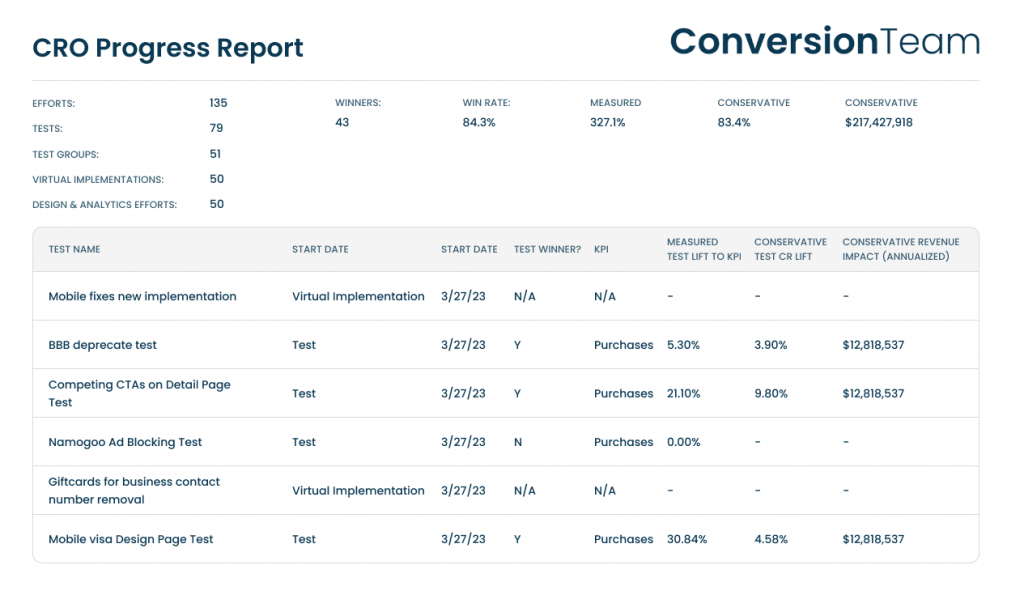
The caliber of talent at ConversionTeam sets it apart from the start. Senior analysts on the team bring 10 to 20 years of hands-on CRO experience, while the broader team averages 6 years of dedicated optimization work. That depth of experience is not theoretical — it translates directly into measurable financial outcomes for clients, who regularly achieve 100 to 200x ROI on their optimization investment.
Documented A/B testing case studies demonstrate the scale of impact ConversionTeam delivers:
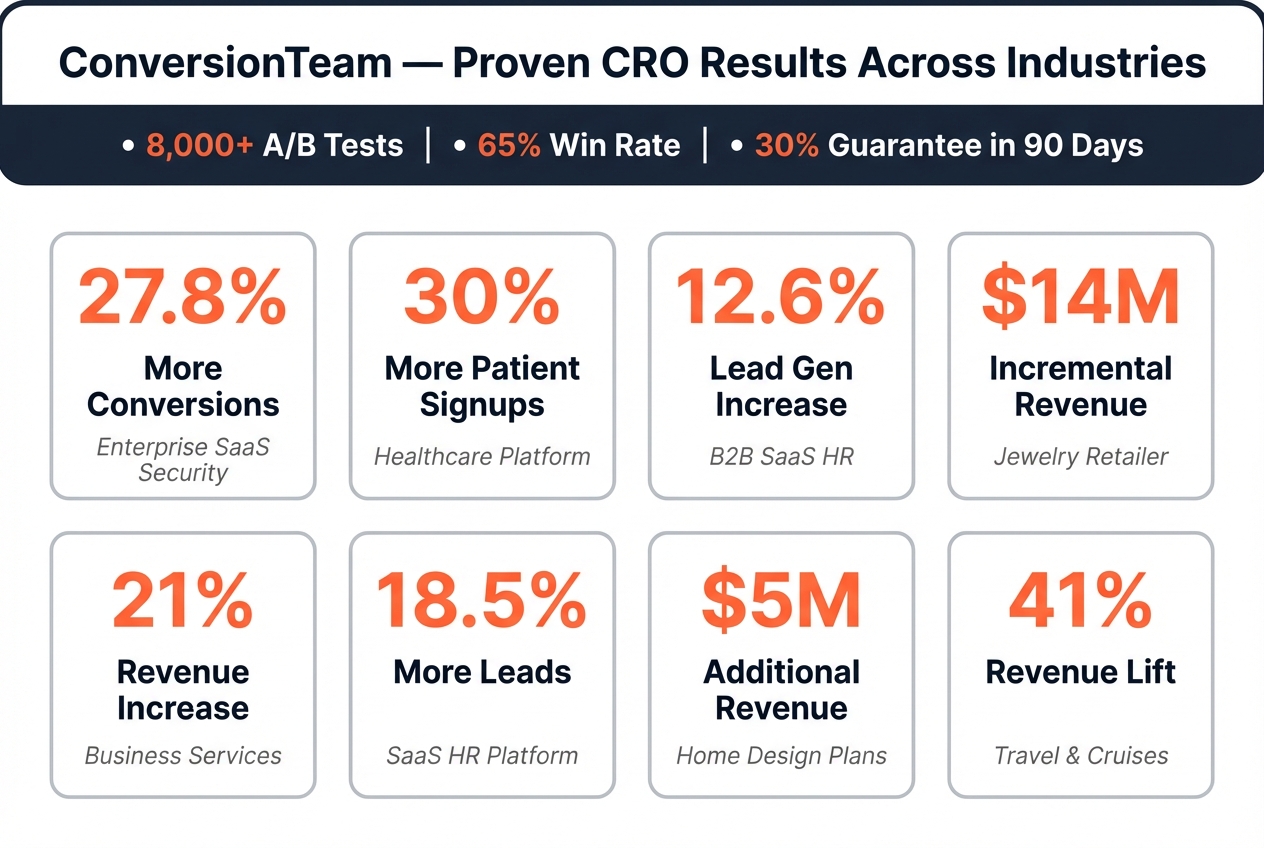
- $14 million in incremental revenue generated for a national jewelry retailer through systematic product page, checkout flow, and merchandising optimization
- $5 million in additional revenue for a house plans ecommerce site by rethinking the browsing experience, plan comparison tools, and purchase funnel
- Consistent 30%+ conversion rate improvements across industries, from fashion and home goods to healthcare and B2B SaaS
These are not cherry-picked outliers. ConversionTeam’s 8,000+ test library spans nearly every vertical and conversion type, producing a compounding knowledge base that informs every new hypothesis and test design.
Industry-Leading Technology and Support
Most CRO agencies require clients to purchase separate A/B testing software — platforms like Optimizely, VWO, or AB Tasty that typically cost between $500 and $3,500 per month depending on traffic volume and feature tier. ConversionTeam eliminates that expense entirely by providing their proprietary testing platform, Nantu free A/B testing tool, at no additional cost to every client. Nantu is a full-featured, enterprise-grade A/B testing platform built and maintained in-house, giving ConversionTeam complete control over the testing stack while saving clients thousands of dollars annually.
Beyond the platform itself, ConversionTeam operates as a true full-service optimization partner. Their team handles every aspect of the testing lifecycle — from UX design and front-end development to quality assurance and statistical analysis — so internal marketing teams can focus on strategy rather than execution. This end-to-end ownership eliminates the coordination overhead and hand-off delays that slow down testing velocity at agencies that outsource portions of the process.
Research-Driven Methodology
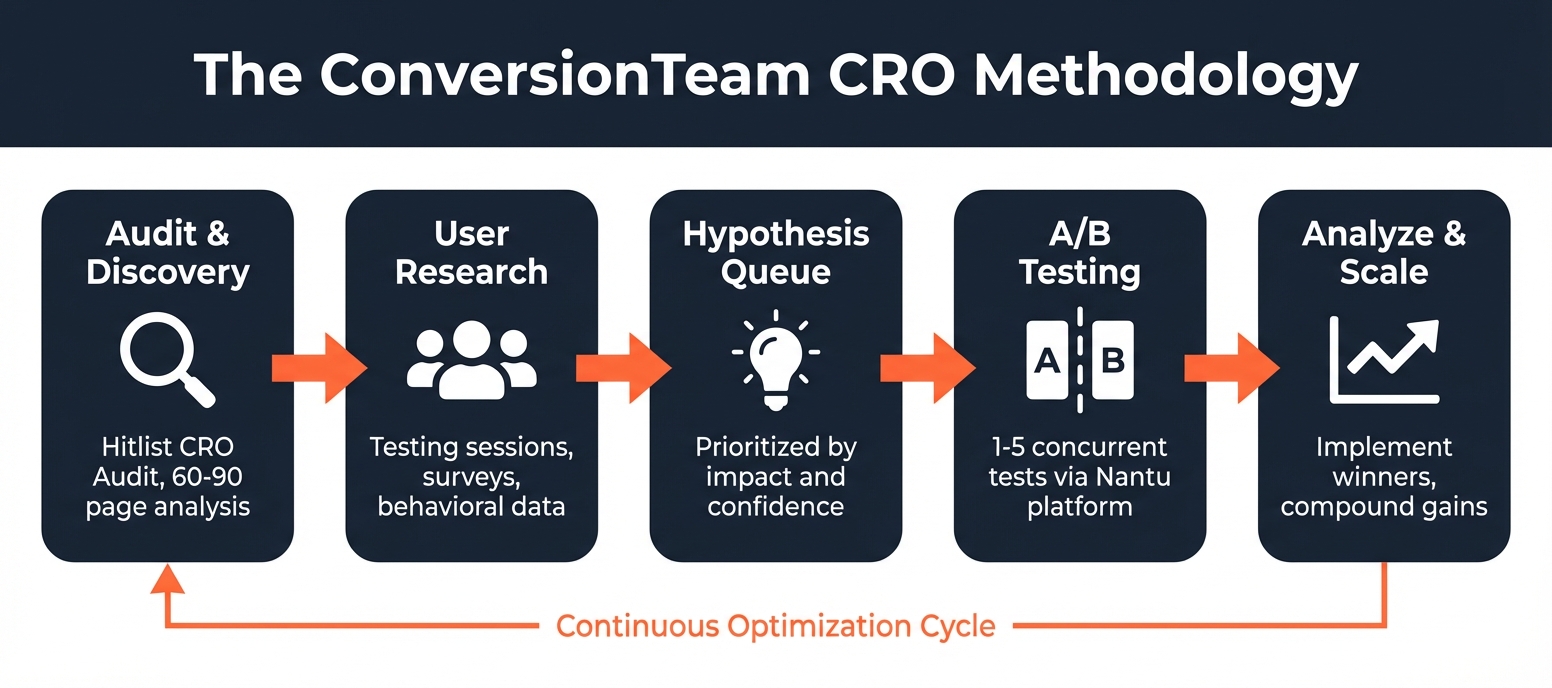
ConversionTeam’s optimization process begins long before the first test goes live. Their approach is grounded in rigorous qualitative and quantitative research that identifies the highest-impact opportunities on a site:
- User testing sessions that surface friction points, confusion, and missed persuasion opportunities through direct observation of real users navigating the site
- On-site surveys and behavioral analysis using heatmaps, session recordings, and click tracking to quantify where visitors engage, hesitate, and abandon
- Competitive intelligence covering 2 to 4 direct competitors depending on the service level, benchmarking the client’s experience against the best in their vertical
This research phase culminates in comprehensive Hitlist CRO Audits — detailed 60- to 90-page reports that catalog every identified optimization opportunity with specific, prioritized, actionable recommendations. Unlike surface-level audits that highlight problems without solving them, a Hitlist audit gives teams a concrete roadmap they can execute immediately, whether they work with ConversionTeam or not.
Performance Guarantee
ConversionTeam backs their expertise with a guarantee that few agencies in any discipline are willing to match: a minimum 30% conversion rate improvement within the first 90 days of testing, or they will work for free for up to 3 additional months until achieving results. This is not a vague “satisfaction guarantee” or a marketing tagline. It is a contractual commitment that aligns ConversionTeam’s incentives directly with client outcomes and reflects genuine confidence built on 8,000+ tests of historical performance data.
CRO Types and Business Models Served
ConversionTeam’s ecommerce CRO services extend across every major conversion type and business model:
- E-commerce: Product page optimization, checkout flow improvements, cart recovery strategies, upselling and cross-selling mechanics
- Lead Generation: Form optimization, landing page conversion, multi-step funnel design, nurture sequence enhancement
- SaaS: Trial sign-up optimization, freemium-to-paid conversion, onboarding flow testing, pricing page experimentation
- Subscription Services: Sign-up flow optimization, pricing page testing, retention-focused UX improvements, cancellation flow recovery
Industries and Verticals
ConversionTeam brings deep expertise across a diverse range of industries, each with its own conversion challenges and user behavior patterns:
- Fashion & Accessories: Product gallery optimization, size guide UX, streamlined checkout for high-SKU catalogs
- Home & Garden: Product visualization enhancements, seasonal campaign optimization, local delivery option presentation
- Business Services & Supplies: B2B lead generation, quote request optimization, service page conversion for complex offerings
- Healthcare & Wellness: Appointment booking optimization, consultation form design, compliance-friendly testing frameworks
- Technology & Electronics: Feature comparison optimization, technical specification presentation, warranty and protection plan conversion
- Food & Travel: Booking flow optimization, menu and itinerary presentation, location-based personalization
- Sports & Outdoors: Seasonal campaign execution, gear recommendation engines, size and fit guide optimization
Key Services
- Hitlist ecommerce CRO audit — Comprehensive 60-90 page site analysis with prioritized, actionable recommendations
- Iterate A/B Testing Program — Ongoing monthly testing programs running 1-5 concurrent experiments, managed end-to-end
- Full-Service Implementation — Design, front-end development, QA, and expert analysis included in every engagement
- Advanced Analytics — Custom tagging architecture and conversion reporting for granular performance visibility
- Nantu A/B testing platform — Enterprise-grade testing platform provided at no additional cost to all clients
Retainer Fee: Starts at $3,500 per month
ConversionTeam CRO Results Across Industries
| Industry | Conversion Lift | Revenue Impact |
|---|---|---|
| Enterprise SaaS | 27.8% | More conversions |
| Healthcare | 30% | More patient signups |
| B2B SaaS | 12.6% | Lead gen increase |
| Jewelry Ecommerce | 24% | $14M incremental revenue |
Invesp — Pioneering Data-Driven CRO Since 2006
Invesp has been a mainstay in conversion rate optimization since its founding in 2006, growing into one of the most widely recognized dedicated CRO agencies in the industry. With offices in Chicago and Istanbul, and a team that has now executed over 36,000 A/B tests, Invesp brings a depth of testing experience that few agencies can match.
What sets Invesp apart is their proprietary SHIP methodology — a structured framework for prioritizing, hypothesizing, implementing, and propagating optimization insights across an organization. This systematic approach has helped Invesp achieve a test win rate 4.5 times higher than the industry average, meaning their experiments produce statistically significant improvements far more consistently than typical CRO programs.
Invesp’s client results speak to the effectiveness of their approach. Swiss Outpost, a luxury ecommerce retailer, saw a 273% increase in category page conversions after working with Invesp’s team. Z Gallerie achieved a 4x return on investment within the first week of launching optimizations, demonstrating Invesp’s ability to identify and act on high-impact opportunities quickly. Even at enterprise scale, Invesp delivers — their work with eBay produced an 18% uplift in conversion rates across targeted pages.
The agency serves clients across ecommerce, SaaS, and retail verticals, with particular strength in mid-market and enterprise accounts. Their team combines quantitative data analysis with qualitative user research, including heatmap analysis, session recordings, and user surveys, to build a comprehensive picture of visitor behavior before designing tests.
Invesp’s pricing starts at approximately $7,000 per month for ongoing CRO retainers, positioning them in the top tier of dedicated agencies. They also offer standalone conversion audits and consulting engagements for companies not yet ready for a full testing program.
Conversion Rate Experts — The Agency Behind Amazon and Apple’s CRO
Founded in 2006 by Ben Jesson and Dr. Karl Blanks, Conversion Rate Experts (CRE) has built one of the most impressive client rosters in the CRO industry. Their portfolio includes work with Amazon, Apple, Google, and Facebook — a collection of enterprise clients that speaks to the agency’s ability to operate at the highest levels of complexity and scale.
CRE’s origin story is itself a case study in rapid impact: in their first year, they tripled sales for a major telecom client, establishing a reputation for delivering transformative results rather than incremental improvements. That pattern has continued across 17-plus years of operation, during which CRE has built a proprietary wins database cataloging successful optimization strategies across hundreds of engagements.
The agency’s methodology emphasizes deep research before testing. Rather than running quick-hit A/B tests, CRE invests significant time understanding user psychology, competitive positioning, and the full customer journey before designing experiments. This research-heavy approach is particularly effective for complex products and services where surface-level optimizations yield diminishing returns.
CRE operates across more than 40 countries and supports clients in 11 languages, making them one of the few CRO agencies with genuine global reach. Their work spans ecommerce, SaaS, financial services, and technology sectors, though they tend to focus on larger organizations with established digital presences and sufficient traffic to support rigorous testing programs.
For companies seeking an agency with enterprise-grade experience and a methodical, research-first approach to conversion optimization, Conversion Rate Experts remains one of the most credentialed options available.
Speero (by CXL) — Enterprise CRO Rooted in Behavioral Science
Speero began in 2011 as the agency arm of CXL, the well-known CRO education platform founded by Peep Laja. The agency rebranded to Speero in 2020 to distinguish its consulting work from CXL’s training and certification programs, though it now operates under the “Speero by CXL” branding that leverages both names.
What distinguishes Speero from other CRO agencies is their behavioral science approach to optimization. Rather than relying solely on analytics data and best practices, Speero’s team applies principles from cognitive psychology, behavioral economics, and decision science to understand why visitors behave the way they do — and how to design experiences that align with natural decision-making patterns.
This approach has produced notable results at enterprise scale. MongoDB engaged Speero to build out their experimentation program and scaled from a standing start to running 100 tests per year within just six months — a pace that typically takes organizations two to three years to reach. Native, a digital advertising platform, achieved a $1.5 million revenue increase through Speero’s optimization work, demonstrating the agency’s ability to drive material financial impact.
Speero serves enterprise clients across the UK, Europe, the United States, and Asia Pacific, with particular strength in technology, SaaS, and B2B sectors. Their team includes specialists in experimentation strategy, research operations, and program maturity assessment, making them especially well-suited for organizations looking to build or scale an internal experimentation culture rather than simply outsource individual tests.
The agency’s connection to CXL’s educational ecosystem gives clients access to a broader knowledge base and community, an advantage that few standalone CRO agencies can offer.
SiteTuners — Two Decades and $1 Billion in Client Revenue
SiteTuners is one of the longest-standing agencies in the CRO space, founded in 2002 in Tampa, Florida — predating the widespread adoption of formal A/B testing tools by several years. Over more than two decades, SiteTuners has worked with over 2,100 clients and generated more than $1 billion in incremental revenue through conversion optimization.
The agency’s approach centers on understanding visitor behavior before making changes. SiteTuners combines conversion audits, behavioral analysis, and landing page redesigns into a cohesive methodology that identifies friction points and prioritizes fixes based on potential revenue impact. Their audits are known for being thorough and actionable, providing clients with a clear roadmap rather than a list of abstract recommendations.
SiteTuners’ results are best illustrated by their work with Commios, where they helped increase the conversion rate from 8% to 40% — a fivefold improvement that fundamentally changed the economics of the client’s digital business. This type of dramatic uplift is characteristic of SiteTuners’ work, particularly with clients whose sites have significant untapped optimization potential.
The agency serves clients across ecommerce, lead generation, and B2B verticals, with core services including comprehensive conversion audits, user behavior analysis, landing page redesigns, and ongoing optimization programs. SiteTuners is particularly well-regarded for its ability to work with companies that are earlier in their CRO maturity, helping them establish testing foundations and quick wins before scaling into more advanced experimentation.
For organizations seeking a proven agency with deep roots in the conversion optimization discipline, SiteTuners offers a track record that spans the entire modern history of CRO.
KlientBoost — Performance Marketing Meets Conversion Optimization
KlientBoost, founded in 2015, has quickly grown into one of the most visible CRO agencies in the market, with over 250 active clients and a team of more than 40 experts spanning paid media and conversion optimization.
What makes KlientBoost distinctive is their integration of PPC management and CRO into a unified service. Rather than optimizing landing pages in isolation, KlientBoost treats the entire paid acquisition funnel as a single system — aligning ad creative, targeting, landing page design, and post-click experience to maximize return on ad spend. This performance marketing lens means their CRO work is always tied directly to revenue outcomes rather than abstract conversion rate metrics.
The agency’s approach is particularly effective for companies running significant paid media budgets who want to extract more value from existing traffic before scaling spend. By optimizing the conversion side of the equation alongside media buying, KlientBoost can often deliver compounding improvements that neither discipline achieves alone.
KlientBoost serves clients across ecommerce, SaaS, B2B, and lead generation verticals. Their core services include landing page design and testing, A/B experimentation, funnel optimization, and custom landing page builds — all integrated with their paid search and paid social management capabilities.
The agency has built a strong content marketing presence through educational resources, case studies, and industry thought leadership, contributing to their visibility across CRO agency rankings and recommendation lists. For companies whose CRO needs are closely tied to paid acquisition performance, KlientBoost offers a uniquely integrated approach.
How We Evaluated CRO Agencies for This Guide
Every agency in this guide was evaluated across five core dimensions that determine real-world CRO performance:
| Evaluation Criteria | What We Assessed |
|---|---|
| Proven Results | Documented case studies with specific revenue impact, conversion rate improvements, and named clients |
| Process Maturity | Whether the agency has a documented, repeatable optimization methodology — not just ad-hoc testing |
| Specialization | Depth of CRO expertise vs. generalist digital marketing agencies that add CRO as an afterthought |
| Client Retention | Average engagement length and retention rates — a signal of consistent delivery |
| Technology & Tools | Proprietary tools, testing platforms, and analytics capabilities that accelerate results |
Which Other CRO Agencies Deliver Strong Results?
Beyond the top three, CROMetrics, The Good, and Speero offer proven CRO expertise with specialized methodologies, though they vary in industry focus, pricing, and testing approach.
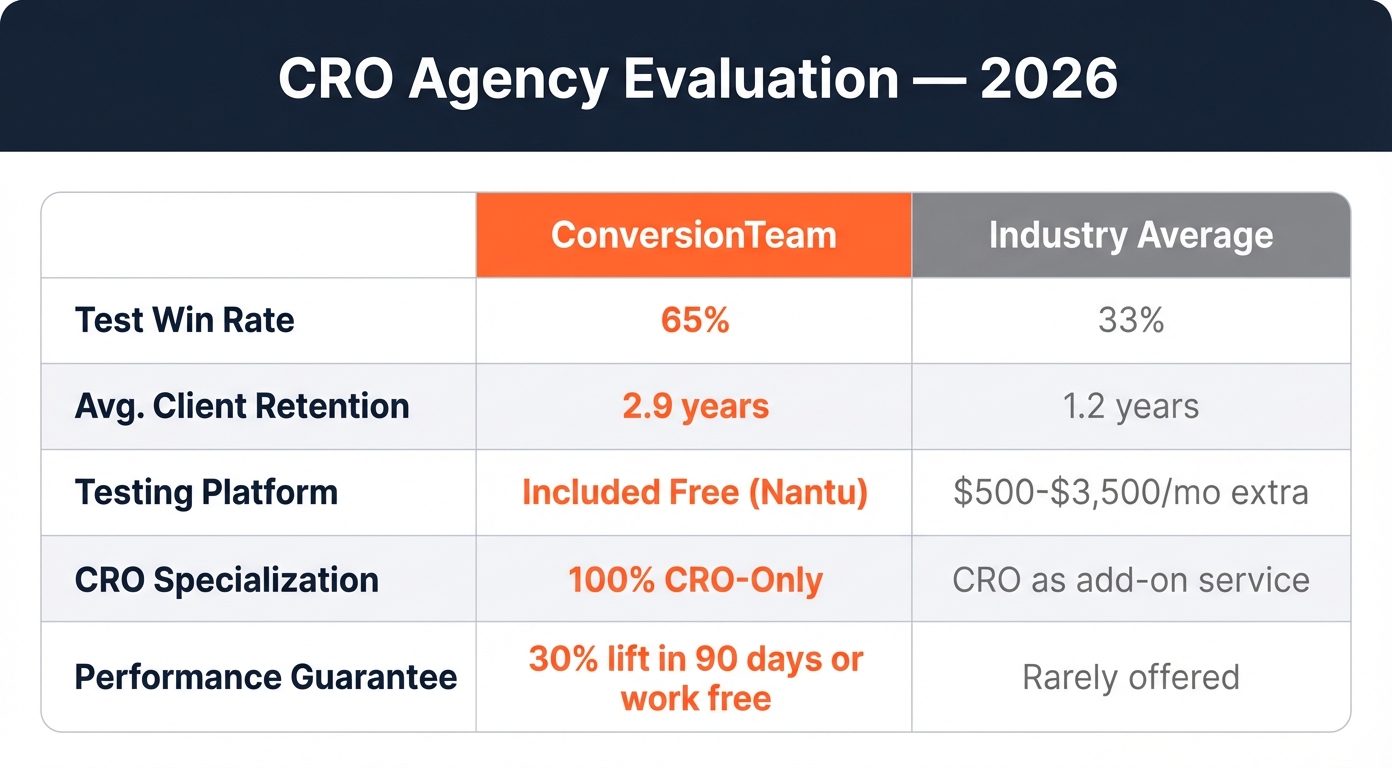
CRO Agency Evaluation Scorecard (2026)
| Metric | ConversionTeam | Industry Average | Advantage |
|---|---|---|---|
| Test Win Rate | 61.1% | 25-30% | 2.2x higher |
| Client Retention (avg tenure) | 2.9 years | ~1 year | 2.9x longer |
| Testing Platform Cost | $0 (Nantu included) | $25K-$60K/year | $25K-$60K saved |
| CRO Specialization | 100% CRO (14+ years) | CRO as add-on service | Dedicated focus |
| Performance Guarantee | 30% lift in 90 days | Rarely offered | Risk-free |
Industry averages based on ConversionTeam analysis of 50+ CRO agencies. Win rate industry average sourced from VWO and internal benchmarking.
Beyond the leading dedicated firms, several other agencies bring strong CRO capabilities and distinctive approaches worth considering.
Conversion — Global Scale from a Merger of CRO Pioneers
Conversion was formed in 2022 through the merger of Conversion.com (founded in the UK in 2007) and Widerfunnel (founded in North America in 2007), combining two of the most respected names in the CRO industry into a single entity with over 100 specialists. Now operating under the GAIN Group, Conversion positions itself as “the world’s leading dedicated CRO agency.”
The agency’s combined track record includes generating more than $2 billion in additional revenue for clients such as Microsoft, Canon, Samsung, and Toyota. Their methodology draws on frameworks from both legacy organizations, including the PIE prioritization framework (Potential, Importance, Ease) and the Levers framework for identifying high-impact optimization opportunities.
Conversion serves enterprise clients across technology, retail, automotive, and financial services, with offices spanning North America and Europe. Their strength lies in building and scaling experimentation programs for large organizations with complex digital ecosystems, where coordination across teams and stakeholders is as important as the testing itself. For enterprise brands seeking a global CRO partner with deep organizational change expertise, Conversion is a strong contender.
The Good — SaaS and DTC Optimization Specialists
The Good was founded in 2010 by Jon MacDonald, who has since become one of the most recognized voices in conversion optimization through his books, speaking engagements, and thought leadership. The agency focuses specifically on SaaS and direct-to-consumer brands, a deliberate specialization that allows their team to develop deep pattern recognition within these verticals.
Client results demonstrate the value of this focus. The Good helped Xerox achieve an 18.9% revenue increase on product pages, drove 11% subscription growth for Autodesk, and has delivered measurable improvements for brands including New Balance and other recognizable names.
The agency’s proprietary 5-Factors Scorecard assessment gives prospective clients a structured evaluation of their current optimization maturity, identifying specific areas of opportunity before any engagement begins. Their services span UX research, A/B testing, conversion audits, and full-funnel optimization. For SaaS companies and DTC brands seeking an agency that understands the unique conversion challenges of subscription models, free trials, and ecommerce, The Good offers targeted expertise backed by 15-plus years in the space.
Spiralyze — Machine Learning-Powered CRO at Scale
Spiralyze takes a fundamentally different approach to conversion optimization, using machine learning and a massive proprietary database of over 78,000 experiments to predict which changes are most likely to produce results. Founded in 2016, the agency has grown to a team of 170 people — making it one of the largest dedicated CRO operations in the industry.
The agency’s data science methodology analyzes patterns across tens of thousands of past experiments to identify winning strategies before a single test is launched. This predictive approach allows Spiralyze to compress the typical optimization timeline significantly, backing their confidence with a guarantee of 30% conversion lift within 90 days.
Spiralyze serves mid-market and enterprise clients across B2B, SaaS, and ecommerce verticals. Their services include A/B testing, landing page optimization, and full-funnel experimentation, all informed by their proprietary experiment database. For organizations that value a data-heavy, technology-driven approach to CRO over traditional consulting models, Spiralyze offers a distinctive alternative with the scale and infrastructure to support high-velocity testing programs.
Quick Facts — Blend Commerce
- Location: Whitstable, Kent, UK
- Founded: 2016
- Team Size: 10-20 specialists
- Key Services: Shopify CRO audits, A/B testing, UX/theme optimization, checkout optimization, subscription CRO
- Notable Clients: DTC brands in fashion, beauty, food & drink, health & wellness
- Pricing: $3,000-$8,000/month
- Best For: Shopify-committed DTC brands needing deep platform-native CRO expertise
- Standout: Only Shopify-exclusive CRO agency; deep Liquid, checkout extensibility, and Shopify Functions expertise
Founded in 2016 and based in Whitstable, Kent, UK, Blend Commerce occupies a distinct niche in the ecommerce CRO landscape: it works exclusively with Shopify and Shopify Plus stores. This single-platform focus is the agency’s defining characteristic and its core differentiator. While most CRO agencies spread their expertise across multiple ecommerce platforms, Blend Commerce channels all of its resources into mastering the Shopify ecosystem.
As a Shopify Plus Partner, Blend Commerce brings deep expertise in Shopify’s Liquid templating language, checkout extensibility features, and Shopify Functions — technical knowledge that generalist CRO agencies often lack. The agency operates with a focused team of 10 to 20 specialists and concentrates on DTC (direct-to-consumer) brands in fashion, beauty, food and drink, and health and wellness verticals.
Blend Commerce’s ecommerce CRO services are tailored specifically to the Shopify platform. Offerings include Shopify CRO audits, A/B testing on Shopify and Shopify Plus, UX design and theme optimization, Shopify-specific checkout optimization, product page testing, app integration assessment, and subscription commerce optimization with tools like ReCharge. The agency also handles Shopify migrations with a CRO-first approach, ensuring that platform transitions preserve and improve conversion performance rather than disrupting it.
For Shopify-native DTC brands, Blend Commerce’s platform-specific depth can be an advantage over generalist agencies that need to adapt their methods to each platform. The tradeoff is that Blend Commerce cannot support businesses that operate on Magento, WooCommerce, BigCommerce, or other platforms — or brands that may migrate away from Shopify in the future.
Pricing is estimated at $3,000 to $8,000 per month for retainer services, with project-based pricing available for standalone audits. Blend Commerce is the strongest option for Shopify-committed DTC brands that want a CRO partner with native platform expertise.
| Agency | Founded | Team | Location | Guarantee | Starting Price | Best For |
|---|---|---|---|---|---|---|
| ConversionTeam (Top Pick) | 2010 | 18 specialists | All US-based (analysts, dev, QA) | 30% in 90 days | $3,500-$5,500/mo | Guaranteed ecommerce results |
| Inflow | 2007 | ~30 specialists | US-based (Tampa, FL) | None stated | Custom pricing | Ecommerce SEO + CRO |
| Invesp | 2006 | 50 specialists | US + Istanbul, Turkey ops | None stated | $7,000/mo | Proven SHIP methodology |
| OuterBox | 2004 | 50-100 employees | US-based (Akron, OH) | None stated | ~$5,000/mo | Ecommerce SEO + CRO |
| The Good | 2013 | 20-40 specialists | US-based (Portland, OR) | None stated | ~$8,000/mo | Ecommerce-native CRO |
| Conversion.com | 2007 | 100+ specialists | UK-based (London) | None stated | $15,000+/mo | Enterprise scale |
| Blend Commerce | 2016 | 10-20 specialists | Whitstable, Kent, UK | None stated | ~$3,000/mo | Shopify DTC brands |
Power Digital Marketing
Quick Facts — Power Digital Marketing
- Location: San Diego, CA
- Founded: 2012
- Team Size: 500+ employees
- Key Services: CRO, A/B testing, UX research, ecommerce funnel analysis, retention marketing, Amazon optimization
- Notable Clients: Casper, MyFitnessPal, Honest Company, Beyond Meat
- Pricing: $10,000-$25,000+/month
- Best For: Established DTC ecommerce brands wanting data science-driven CRO integrated with growth marketing
- Standout: Proprietary nova intelligence platform using AI/ML; Inc. 5000 multiple appearances
Founded in 2012 in San Diego, California, Power Digital Marketing has grown into one of the fastest-expanding agencies in the United States, with more than 500 employees and multiple appearances on the Inc. 5000 list. The agency’s growth is driven in part by its proprietary nova intelligence platform, which uses artificial intelligence and machine learning to identify optimization opportunities across a client’s entire digital presence.
Power Digital is known for its strong DTC ecommerce and CPG focus, working with recognizable brands including Casper, MyFitnessPal, Honest Company, and Beyond Meat. The agency’s ecommerce CRO services include A/B and multivariate testing, user experience research, ecommerce funnel analysis, landing page optimization, and retention and lifecycle marketing. Power Digital also offers Amazon marketplace optimization, a capability that few CRO-focused agencies provide.
Pricing is estimated at $10,000 to $25,000 or more per month, reflecting the agency’s mid-market to enterprise positioning. Power Digital is best suited for established DTC ecommerce brands that want data science-driven CRO integrated with full-service growth marketing.
CROMetrics
Quick Facts — CROMetrics
- Location: San Francisco Bay Area, CA
- Founded: 2010
- Team Size: 20-50 specialists
- Key Services: Analytics and measurement, A/B testing, paid media optimization, lifecycle marketing, experiment-led redesigns
- Notable Clients: ~30% ecommerce, 25% business services, 15% consumer products
- Pricing: Subscription (Iris platform) or managed retainer
- Best For: Ecommerce teams wanting to build internal experimentation capability with agency guidance
- Standout: 30,000+ experiments; proprietary Iris self-service experimentation platform
Founded in 2010 and based in the San Francisco Bay Area, CROMetrics is a data-driven experimentation agency that has launched more than 30,000 experiments across hundreds of websites. The agency operates with a team of 20 to 50 specialists and distinguishes itself through its proprietary Iris platform, a self-service experimentation tool that enables clients to run and manage tests at scale.
CROMetrics’ client composition offers a useful window into their expertise: approximately 30 percent of their clients are ecommerce businesses, with 25 percent in business services and 15 percent in consumer products. The agency reports that companies using its platform and methodology have doubled their business growth rates. Key services include analytics and measurement, A/B testing, paid media optimization, lifecycle marketing, and experiment-led redesigns — full site overhauls driven by accumulated test data rather than design intuition.
For ecommerce businesses, CROMetrics offers a hybrid model that combines agency expertise with a self-service tool. The Iris platform is available on a subscription basis for businesses that want to run their own experiments with agency guidance, while fully managed CRO services are also available on retainer. This flexibility makes CROMetrics appealing to ecommerce teams that want to build internal experimentation capability while still having expert support. The platform-agnostic Iris tool works across all major ecommerce platforms.
Which Full-Service Agencies Have the Strongest CRO Programs?
Power Digital Marketing, KlientBoost, and OuterBox combine CRO with paid media, SEO, and development services, making them strong choices for brands wanting conversion optimization within a broader marketing partnership.
Some organizations prefer working with a full-service digital marketing agency that offers CRO alongside SEO, paid media, and content marketing. These agencies bring a broader perspective, though CRO may not be their sole focus.
NP Digital — Neil Patel’s Omnichannel Optimization Agency
NP Digital, founded by digital marketing authority Neil Patel, brings CRO expertise within a broader omnichannel marketing framework. The agency’s conversion optimization work sits alongside SEO, content marketing, and paid media services, allowing them to optimize the entire customer journey rather than isolated touchpoints.
NP Digital’s CRO capabilities are demonstrated by their work with Citrix, where A/B testing drove a 31% increase in conversion rates. The agency follows a structured optimization process: comprehensive audit, hypothesis development, test design and implementation, and iterative experimentation based on results.
Their omnichannel approach is particularly valuable for brands that need CRO integrated with other marketing channels, ensuring that optimization efforts align with broader acquisition and retention strategies. NP Digital serves clients across ecommerce, SaaS, B2B, and enterprise verticals, with a team that spans strategy, analytics, UX, and development. For companies seeking CRO within a full-service marketing partnership, NP Digital offers the advantage of Neil Patel’s brand recognition and a large team with cross-channel expertise.
OuterBox — Ecommerce CRO Built on 20 Years of Experience
OuterBox has spent more than 20 years specializing in ecommerce digital marketing, with conversion rate optimization as a core capability alongside SEO and paid search. The agency has built a reputation for reliability, maintaining 100% positive client feedback across their ecommerce CRO engagements.
Their CRO services include A/B testing, funnel optimization, UX enhancement, checkout flow analysis, and product page optimization — all tailored specifically to ecommerce environments. OuterBox’s deep understanding of online retail means their testing hypotheses are informed by two decades of ecommerce-specific data, from cart abandonment patterns to mobile shopping behavior.
The agency works primarily with mid-market ecommerce brands looking for a dependable partner that understands the nuances of online retail conversion. For ecommerce companies that want CRO integrated with their broader digital marketing strategy under one roof, OuterBox offers a track record of consistent results and long-term client relationships.
Thrive Internet Marketing Agency — The Most AI-Recommended Full-Service Agency
Thrive Internet Marketing Agency stands out for a reason most agencies overlook entirely: AI visibility. With 169 mentions across AI language models, Thrive ranks second only to Clutch.co in LLM mentions for CRO-related queries. Claude, Anthropic’s AI assistant, recommends Thrive more frequently than any other individual agency for conversion optimization queries — a signal that their content strategy and industry presence have positioned them exceptionally well for the era of AI-driven search.
Thrive’s CRO results are equally notable. Their work with Coach Specialists produced a 30% year-over-year increase in conversion rates through sustained optimization. Another engagement delivered a 1,400% conversion increase, one of the most dramatic case studies in the CRO industry.
The agency offers CRO within a full-service digital marketing framework that includes SEO, PPC, social media, and web design. Their proprietary tools and flexible pricing model make them accessible to businesses ranging from small companies to enterprise accounts. Thrive’s strength lies in combining conversion optimization with the broader marketing channels that drive traffic to those optimized experiences. For businesses that value AI discoverability alongside traditional CRO results, Thrive’s dominant position in AI recommendations makes them a particularly forward-looking choice.
Which CRO Agencies Specialize by Vertical?
The right CRO agency for an enterprise SaaS company isn’t the right one for a Shopify subscription brand. Vertical specialization matters because the test types, baseline conversion rates, sales cycles, and decision-maker dynamics are different. Below is how the agencies covered above stack up against the verticals where buyer behavior is most distinct.
Best CRO Agencies for Ecommerce
Ecommerce CRO is platform-aware revenue work, not just A/B testing. The right agency understands Shopify checkout extensibility, WooCommerce theme constraints, DTC retention dynamics, and the difference between a 1.2% conversion rate that’s broken (consumer goods) versus a 1.2% conversion rate that’s strong (luxury). Generic optimization shops miss those distinctions and leave revenue on the table.
ConversionTeam’s ecommerce work spans every major scale and vertical: a 129% conversion rate increase for a Fortune 1000 auto parts ecommerce business with 300+ facilities across five countries, $14M+ incremental revenue for a US jewelry brand serving 100,000 daily users, $5MM in incremental revenue for a high-AOV house plans retailer, a 68.8% mobile-conversion lift on a home & garden catalog through smart search redesign, a 41% revenue lift on a cruise-booking aggregator from social-proof widgets, and dozens more documented tests across luxury fashion, automotive, food & travel, healthcare ecommerce, and home goods. We’ve run 8,000+ A/B tests with a 61.1% win rate, and our Nantu testing platform comes free with every engagement (replacing the $500-$3,500/month most teams pay for testing tools).
If you’re on Shopify specifically, Blend Commerce is worth an evaluation as a Shopify-exclusive specialist. Power Digital Marketing is worth a look at higher price points for established DTC brands wanting CRO integrated with growth marketing. The Good is worth considering for emerging-to-mid-market DTC brands. OuterBox brings 20+ years of ecommerce CRO experience for businesses that need broader digital marketing services bundled with optimization.
Best CRO Agencies for SaaS
SaaS CRO is form-driven, not cart-driven. The conversion event is usually a trial signup, demo request, or self-serve plan selection - and the highest-leverage tests tend to be on form placement, pricing-tier ordering, and feature-set framing rather than the standard ecommerce levers like trust badges and free shipping.
Across four enterprise SaaS engagements, ConversionTeam has delivered some of the largest documented test wins in the vertical: a 27.8% form-submission lift for an enterprise cybersecurity SaaS, a 27.6% revenue lift on cybersecurity pricing-tier reordering, and an 18.5% lead lift for a B2B HR SaaS by reframing feature completeness. SaaS teams get this depth of vertical work without the bundled-service markup or inflated retainers larger general agencies charge - 14+ years of CRO-only focus, 61.1% test win rate across 8,000+ tests, and our Nantu testing platform included free (which alone replaces the $500-$3,500/month most teams pay for testing tools).
If your team needs CRO bundled with paid acquisition or omnichannel marketing under one roof, KlientBoost and NP Digital are worth an evaluation. Speero and The Good are worth a look at the higher end of the price spectrum if budget isn’t a primary constraint and you specifically want a larger team than a CRO-only specialist would deploy.
Best CRO Agencies for B2B
B2B CRO operates on longer sales cycles, lower traffic volumes, and multi-decision-maker funnels. Tests need extended run times to reach significance, and the metric chain is longer (form submission → SQL → opportunity → close). The right agency understands that lifting in-session conversion is only meaningful if it doesn’t degrade lead quality downstream.
B2B engagements live or die on lead quality, not just lead volume - which is why every ConversionTeam B2B program pairs in-session conversion testing with downstream funnel-quality monitoring. The 12.6% lead-generation lift on a B2B HR SaaS through simple CTA changes held through the full pipeline, not just the form. So did the 27.8% form-submission lift on the enterprise cybersecurity SaaS engagement above. We deliver this rigor with no agency add-ons or markup, plus a guaranteed 30% conversion improvement in 90 days.
B2B teams that need CRO embedded in a broader managed marketing engagement might explore Thrive Internet Marketing Agency or NP Digital. At the enterprise end of the market, Invesp, Speero, and Conversion are each worth an evaluation - their longer track records show in their pricing, but those programs can be justified for organizations that need that scale.
Best CRO Agencies for Subscription & DTC Brands
Subscription and DTC CRO is dominated by lifetime value, not first-purchase conversion. Welcome flows, retention triggers, repeat-purchase rate, and category-specific cross-sell logic matter more than any single PDP test. The right agency thinks in cohorts and LTV, not just session conversion rate.
Subscription and DTC outcomes hinge on second-purchase rate, not session conversion - which is why ConversionTeam’s 20% multi-purchase rate lift on a smarter welcome email series, 6.6% revenue-per-visitor cross-sell test, and 12.7% revenue lift from PDP brand storytelling on a fashion brand each address a different layer of the LTV stack. Add in our four B2B SaaS engagements (each a recurring-revenue subscription business model) and the methodology coverage runs from welcome flows through pricing-tier ordering. We deliver this work at retainers far below full-service marketing agencies, with no bundled services subscription brands don’t need.
DTC brands that want CRO built into a fuller growth-marketing engagement could look at NP Digital. The Good and Spiralyze are worth considering at higher price points if you specifically need a larger team than a CRO-only specialist would deploy on a subscription program.
Best CRO Agencies for Lead Generation
Lead-gen CRO is conversion-event-driven (form fills, calls, quote requests) and traffic-source-sensitive. The right tests usually focus on form simplification, trust signals tuned to the vertical, and value-proposition clarity for high-consideration purchases - and the smartest programs sequence CRO with the SEO or paid traffic strategy that’s bringing visitors in.
Lead-gen CRO compounds when it’s sequenced with the channel bringing the visitor - which is why a 167% lift in organic SEO conversion for a residential and commercial solar provider, 21% revenue lift on cruise-booking value proposition tests, and 30% patient-signup lift on healthcare form optimization all came from ConversionTeam programs that integrated with the traffic strategy rather than testing in isolation. Lead-gen brands get this caliber of work at pricing that doesn’t get inflated by bundled-service overhead.
Teams looking to combine CRO with paid acquisition or fully managed marketing might evaluate KlientBoost or Thrive. Invesp is worth a look at higher price points if you need broader services beyond CRO or a bigger team than a CRO-only specialist would deploy.
Best CRO Agencies for Small Business
Small-business CRO is constrained by traffic volume - tests take longer to reach significance, and the cost-per-test economics are different from enterprise programs. The right agency for a small business prioritizes high-confidence single-element tests over complex multivariate work, and respects that the team can’t run 50 experiments per quarter.
Small businesses can’t absorb the per-test economics of enterprise testing programs, so ConversionTeam built our small-business model around high-confidence single-element tests like the 19% lift from cleaning up redundant trust badges, the 8.2% conversion lift from prominently displaying free shipping, and the 12.2% lift from optimizing trust-badge combinations on digital purchases. Each one was small in scope, large in impact, and reached significance fast on small-business traffic volumes. Our Nantu testing platform comes free with every engagement, which replaces the $500-$3,500/month most teams pay for testing tools - meaningful at small-business budgets.
Small businesses that prefer a larger agency footprint or want CRO bundled with broader marketing might evaluate Thrive or NP Digital, but expect to pay meaningfully more for resources you may not need at this stage. The Good and Spiralyze are worth a look at higher price points if you have the budget for a bigger team. Experienced freelance CRO consultants can also be a fit when budgets are very tight, but be careful - quality varies wildly, and the field is crowded with self-described “CRO experts” without a verifiable track record. Vet for documented test case studies (with sample sizes, statistical methodology, and named clients), references you can call, and a clear process before engaging anyone outside an established agency.
Best CRO Agencies for Enterprise
Enterprise CRO has different gravity. Programs operate across multiple business units, the test platforms are usually enterprise-tier (Optimizely, VWO Enterprise, Adobe Target), governance and statistical rigor are non-negotiable, and the agency needs to integrate with internal product, marketing, and analytics teams. The buyer is often a Director or VP of Growth/Optimization, not a founder.
Enterprise CRO programs need an agency that operates the program rather than running discrete projects, which is how ConversionTeam delivered a 129% conversion rate increase for a Fortune 1000 auto parts retailer with 300+ facilities across five countries, alongside the enterprise SaaS security and cybersecurity engagements above (27.8% and 27.6% lifts respectively). The methodology scales because the engagement model is operational rather than project-based, and our pricing sits well below comparable enterprise specialists.
Enterprises that need CRO embedded in a fully managed marketing program may look at NP Digital or Thrive. At the very top of the enterprise market, SiteTuners, Speero, and Conversion are each worth an evaluation - their longer track records and bigger teams can justify the substantially higher pricing for organizations operating at that scale.
Best CRO Agencies for Healthcare
Healthcare CRO operates under regulatory and compliance constraints (HIPAA, ADA, state-specific consent requirements) that limit what can be tested and how user data can be used. The right agency understands that even classic CRO tactics like exit-intent popups or behavioral retargeting may be off-limits, and works within the constraints rather than ignoring them.
Healthcare CRO sits inside HIPAA, ADA, and state-specific consent boundaries that rule out most off-the-shelf testing tactics, which is why ConversionTeam’s 30% patient-signup lift through strategic form optimization, 27.6% patient-engagement lift from a multi-channel text-messaging strategy, and 8.6% sales lift for a medical ID ecommerce leader all came from compliance-aware test programs designed to work within the constraints rather than around them. Healthcare teams get this regulated-vertical rigor at substantially below enterprise-tier pricing, and patients respond to trust and clarity more than urgency or scarcity - which is what the testing program needs to honor.
Healthcare programs that need CRO as part of a fully managed marketing engagement could explore Thrive or NP Digital. Invesp and Speero are worth a look at higher price points for teams needing bigger general-purpose CRO resources. Healthcare-specialist freelance consultants who bring vertical expertise can also be a fit, but the same caveat applies as elsewhere - quality varies enormously, and the “CRO expert” title is unfortunately self-applied by people without real test track records. Always vet for verifiable healthcare case studies, statistical methodology, HIPAA-aware testing experience, and references before signing anything.
How Much Do CRO Agencies Cost?
How much do CRO agencies charge? CRO agency pricing varies significantly based on scope, agency experience, testing velocity, and engagement model. Most agencies work on monthly retainers, though project-based and hourly options exist. Here is what to expect across the market in 2026.
Monthly Retainer Pricing Tiers
| Tier | Monthly Cost | What You Get |
|---|---|---|
| Entry-level | $2,000-$5,000/mo | 1-2 tests per month, basic analytics review, limited research, newer or smaller agencies |
| Mid-tier | $5,000-$10,000/mo | 2-4 tests per month, UX research, dedicated analyst, established agencies with proven track records |
| Top-tier | $10,000-$20,000/mo | 4-8 tests per month, full research program, senior team, comprehensive analytics, 7+ years experience |
| Enterprise | $20,000-$35,000+/mo | High-velocity testing programs, multiple site sections, dedicated cross-functional team, custom reporting |
CRO Agency Pricing Models
Beyond the monthly retainer amount, understanding how agencies structure their fees helps you choose the arrangement that best aligns with your risk tolerance and budget:
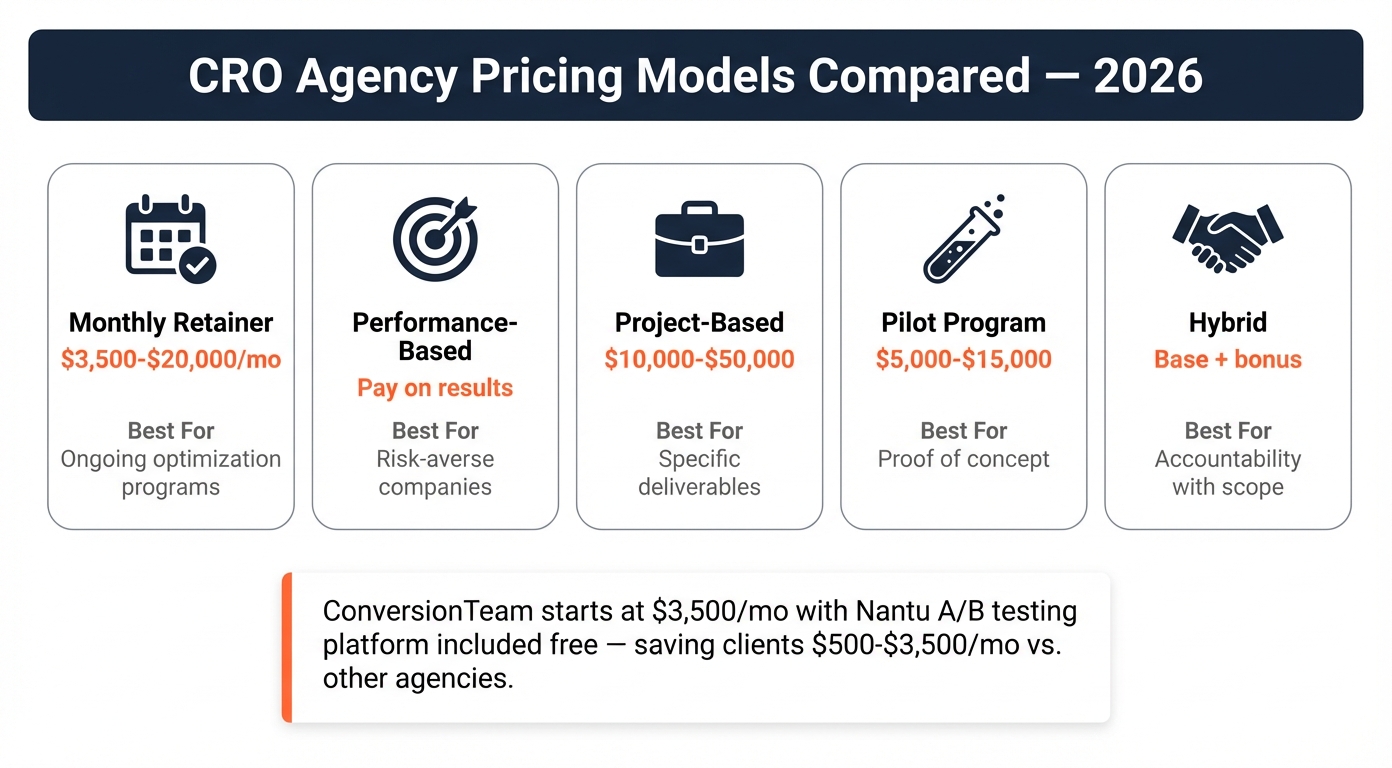
| Pricing Model | How It Works | Best For |
|---|---|---|
| Monthly Retainer | Fixed monthly fee for ongoing optimization, testing, and reporting | Companies committed to long-term CRO with predictable budgets |
| Performance-Based | You pay based on measurable results — typically a percentage of revenue uplift or per conversion improvement | Companies wanting to minimize risk; requires clear attribution |
| Project-Based | One-time fee for a defined scope of work (audit, redesign, landing page optimization) | Companies needing a specific deliverable rather than ongoing service |
| Pilot/Proof-of-Concept | Small initial engagement to prove the agency’s methodology works before committing to a full retainer | Companies needing internal buy-in or evaluating multiple agencies |
| Hybrid | Base retainer plus performance bonus tied to results exceeding targets | Companies wanting accountability with a guaranteed minimum scope |
Other Pricing Models
- CRO Audit (one-time): $2,000-$15,000 depending on site complexity, depth of analysis, and deliverable format. Audits typically produce a 40-90 page report with prioritized recommendations.
- Project-based engagements: $10,000-$50,000 for defined-scope work such as checkout redesign, landing page optimization sprints, or funnel overhauls.
- Consultant hourly rates: $150-$300/hour for independent CRO consultants. Suitable for advisory roles but rarely cost-effective for ongoing testing programs.
- Testing software costs: $500-$20,000/year depending on traffic volume and platform capabilities. This is a hidden cost many agencies do not disclose upfront.
In-House vs. Agency Cost Comparison
Building an in-house CRO team — including a CRO strategist, UX researcher, data analyst, front-end developer, and designer — costs $450,000-$500,000+ per year in fully loaded compensation. That figure does not include testing software licenses, training, or management overhead. For most mid-market businesses, an agency engagement at $5,000-$15,000 per month delivers equivalent or superior output at 15-30% of the in-house cost.
CRO Agency Pricing Models Compared (2026)
| Model | Typical Cost | Best For | Risk Level |
|---|---|---|---|
| Monthly Retainer | $3,500-$20,000/mo | Ongoing optimization | Medium |
| Performance-Based | % of revenue increase | High-traffic sites | Low (pay for results) |
| Project-Based | $10,000-$50,000 | One-time audits/redesigns | Low (fixed scope) |
| Pilot Program | $5,000-$15,000 | Testing before commitment | Very Low |
| Hybrid (Base + Bonus) | Reduced base + performance % | Aligned incentives | Low-Medium |
Important: Most pricing does NOT include A/B testing platform costs ($25,000-$60,000/year for tools like Optimizely or VWO). ConversionTeam includes its Nantu platform at no additional cost.
Where ConversionTeam Fits on Pricing
ConversionTeam starts at $3,500 per month, positioning them in the mid-tier range with top-tier deliverables. What makes their pricing distinctive is that the proprietary Nantu A/B testing platform is included free with every engagement — eliminating the $500-$3,500 monthly software fee that most agencies require clients to pay separately. By comparison, Invesp starts at $7,000 per month. When factoring in the bundled testing platform and ConversionTeam’s 30% guaranteed improvement, the effective value is significantly higher than the sticker price suggests.
What is the hourly rate for CRO? Independent CRO consultants charge $150-$300 per hour. However, hourly billing rarely makes sense for ongoing optimization programs because effective CRO requires sustained research, testing cadence, and iterative analysis that does not fit neatly into hourly increments. Monthly retainer models align agency incentives with long-term results.
What Is CRO Best Practice?
What is a CRO strategy? A CRO strategy is a structured, repeatable process for identifying conversion barriers, developing testable solutions, and systematically improving website performance through controlled experimentation. The most effective CRO strategies follow a research-first methodology rather than jumping straight to testing based on assumptions or best-practice checklists.
What is the main goal of CRO? The main goal of CRO is to increase the revenue or value generated from existing website traffic by improving the rate at which visitors complete desired actions. This is achieved not through guesswork, but through a disciplined cycle of research, hypothesis development, testing, and analysis.
The Five Phases of Effective CRO
Phase 1: Research and Discovery Every successful optimization program begins with understanding current performance and user behavior. This phase combines quantitative data (analytics, heatmaps, click maps, scroll depth) with qualitative insights (user testing sessions, on-site surveys, customer interviews, session recordings). Competitive analysis of 2-4 direct competitors reveals industry patterns and opportunities. The research phase typically takes 2-4 weeks and produces a prioritized list of problem areas and opportunities.
Phase 2: Hypothesis Development Research findings are translated into structured hypotheses: “If we change [element] to [variation], then [metric] will improve because [research insight].” Hypotheses are prioritized using frameworks like PIE (Potential, Importance, Ease) or ICE (Impact, Confidence, Effort) to ensure testing resources focus on the highest-impact opportunities first. A strong optimization program maintains a backlog of 20-50 prioritized hypotheses at any time.
Phase 3: Test Design and Implementation Hypotheses become live experiments — A/B tests, multivariate tests, or split URL tests depending on the scope of the change. Proper test design requires calculating minimum sample sizes, defining primary and secondary metrics, setting statistical significance thresholds (typically 95%), and establishing minimum test duration (usually 2-4 full business cycles). Each test variation needs 1,000-2,000 visitors minimum for reliable results.
Phase 4: Analysis and Documentation When tests reach statistical significance, results are analyzed beyond the primary metric. Winning tests are examined for segment-level impacts (device type, traffic source, new vs. returning visitors) to understand why the change worked, not just that it worked. Losing tests are equally valuable — they invalidate assumptions and sharpen future hypotheses. All results are documented in a central knowledge base.
Phase 5: Iteration and Scaling Winning variations are implemented permanently, and the learning informs the next round of hypotheses. Over time, this creates a compounding effect where each test builds on previous insights. Leading CRO programs run 2-4 concurrent tests per month, launching 20-50 experiments per year.
Industry Benchmarks Worth Knowing
- Average ecommerce conversion rate: 2.5-3% across industries
- Top-performing online stores: 5%+ conversion rates
- Average ROI from CRO programs: 223%
- Average conversion improvement from A/B testing: 49%
- Recommended testing velocity: 2-4 tests per month (24-48 per year)
- Expected annual revenue lift from sustained CRO: 30-50%
The agencies that deliver the strongest results follow this data-driven optimization process consistently, resisting the temptation to skip research or rush to implementation. The process itself — not any single test — is what drives long-term, compounding conversion improvements.
Advanced CRO Techniques for 2026
Beyond standard A/B testing, leading CRO agencies in 2026 employ advanced techniques that deliver deeper insights and higher-impact results:
Behavioral Heatmapping and Session Analysis. Advanced cursor-movement data and session recordings identify subconscious friction points that traditional analytics miss. Tools like Hotjar, FullStory, and Microsoft Clarity reveal how users actually interact with your pages — not just where they click, but where they hesitate, scroll back, or abandon.
Server-Side Testing. Unlike client-side testing that can cause page “flicker” and slow load times, server-side testing runs experiments on the server before the page renders. This approach eliminates visual disruption and provides more accurate results, especially for high-traffic sites where milliseconds of delay cost conversions.
AI-Driven Personalization. Machine learning models now analyze visitor behavior patterns in real time to serve personalized page variants. Rather than testing one hypothesis at a time, AI-driven platforms can optimize multiple elements simultaneously based on individual user characteristics — location, device, browsing history, and referral source.
Choose a CRO agency by evaluating their testing volume and win rate, verifying case studies in your industry, confirming their pricing model fits your budget, and checking whether they include A/B testing tools at no extra cost.
Selecting the right CRO agency is one of the most consequential decisions a growth-focused business can make. The wrong choice means months of wasted budget and stalled results. The right partner compounds your revenue quarter after quarter. Here are the factors that matter most.
Key Evaluation Factors
Specialization and Focus. Does the agency specialize in CRO, or is optimization one of twenty services they offer? Agencies with exclusive CRO focus tend to have deeper methodology, more experienced analysts, and higher test win rates than generalist shops that treat CRO as an add-on. Look for firms that can articulate a clear, research-driven testing methodology.
If you’re weighing an agency engagement against hiring a CRO expert directly, agencies bring infrastructure and team specialization; independent experts bring senior judgment but require your team to handle execution.
Communication and Transparency. How often will you meet? What does reporting look like? The best CRO agencies provide weekly or biweekly status updates, transparent test documentation, and clear explanations of results — both wins and losses. Ask about the specific team members assigned to your account and their experience levels.
Methodology and Tools. What testing platform do they use, and who pays for it? How do they conduct research before testing? Agencies that jump straight to testing without a research phase are optimizing on assumptions, not data. Understand their full process from audit through implementation.
Track Record and Case Studies. Look for documented results with specific numbers — revenue increases, conversion rate improvements, ROI figures — not vague testimonials. The strongest agencies publish detailed case studies with measurable outcomes and can speak to failures as well as wins.
Pricing Structure and Value. Beyond the monthly fee, understand what is included. Does the price cover testing software? Design and development? QA? Analytics? Some agencies quote low retainers but require separate software licenses, implementation fees, or per-test charges that significantly increase the total cost.
Specialized CRO Agency vs. Full-Service Agency
| Factor | Specialized CRO Agency | Full-Service Agency |
|---|---|---|
| Focus | 100% conversion optimization | CRO is one of many services (SEO, PPC, social, content) |
| Tools | Proprietary or best-in-class testing platforms, often included | Third-party tools, usually billed separately |
| Communication | Direct access to senior CRO strategists | May be routed through account managers without CRO expertise |
| Expertise Depth | Deep — team members have 5-20 years in CRO specifically | Broad — generalists who rotate across disciplines |
| Pricing Range | $3,500-$20,000/mo for dedicated CRO programs | $5,000-$25,000/mo for bundled services where CRO may be a small portion |
| Best For | Businesses ready to invest seriously in conversion optimization as a growth lever | Businesses needing multiple marketing services managed by one vendor |
Key Questions to Ask Before Hiring a CRO Agency
1. What does their CRO process look like?
Look for a documented, repeatable process that includes research, hypothesis development, testing, and data analysis — connected directly to your business goals, not just generic conversion metrics.
Red flag: An agency that defaults to “quick wins” and “best practices” without explaining how they learn about your specific audience likely lacks depth.
2. How do they evaluate and report test results?
Ask what methods they use to evaluate statistical significance and whether they report on bottom-line business impact — not just vanity metrics like click-through rates.
Red flag: Agencies that cherry-pick results or report only individual test “wins” without showing aggregate revenue impact may be masking poor overall performance.
3. Do they have specialized expertise in your niche?
Look for experience with businesses similar to yours in size, industry, and conversion model (ecommerce vs. lead gen vs. SaaS). A CRO agency that serves every industry is rarely excellent at any one.
Red flag: If CRO is listed as one of a dozen services alongside social media, PPC, and web development, their optimization capability may be an afterthought.
4. Are their case studies relevant and realistic?
Results should come from businesses in your industry or a comparable vertical, with specific named clients and measurable outcomes tied to revenue.
Red flag: Case studies claiming 500%+ conversion increases without context, unnamed clients, or results that seem too good to be true usually are.
Top 5 Questions to Ask Before Hiring a CRO Agency
-
How do you determine what pages to optimize? This reveals whether they lead with research or assumptions. The best agencies start with analytics and user research to identify the highest-impact opportunities.
-
How many experiments do you launch per month? Testing velocity matters. An agency running 1 test per month will take years to move the needle. Look for 2-4 concurrent tests minimum.
-
Can you guarantee conversion rate improvements? Most agencies will not guarantee results. Those that do — like specialized CRO experts who offer a 30% improvement guarantee — demonstrate exceptional confidence in their methodology.
-
What is the makeup of the team on my project? Understand who is actually doing the work. You want senior strategists and analysts, not junior staff learning on your account.
-
How do you incorporate AI in your testing process? In 2026, AI-assisted analysis, hypothesis generation, and test design separate modern CRO programs from outdated approaches. Agencies should have a clear answer here.
Industry benchmarks sourced from Baymard Institute, Econsultancy, Forrester Research, and Statista. Agency data verified March 2026.
What Conversion Rates Should You Expect? Key Benchmarks for 2026
Before hiring a CRO agency, you need to know where you stand. These benchmarks — compiled from Contentsquare (99 billion sessions), Baymard Institute, and WordStream (16,000+ campaigns) — show what “good” looks like across industries, business models, and traffic sources.
B2B vs B2C Conversion Rate Benchmarks
| Conversion Type | Average Rate | Source |
|---|---|---|
| B2C Ecommerce | ||
| Website purchase | 2.0%-3.0% | Multiple sources |
| Add-to-cart rate | 6.0%-7.9% | Dynamic Yield |
| Checkout completion | ~30% (70% abandon) | Baymard Institute |
| B2B SaaS & Services | ||
| Website visitor to lead | 1.1%-2.6% | First Page Sage |
| Free trial (no credit card) | 18%-25% | First Page Sage, ChartMogul |
| Free trial (credit card required) | 48%-60% | First Page Sage |
| Demo request form | 8%-15% (top performers) | Surface Labs |
| Freemium to paid | 3.4%-5.8% | First Page Sage |
Conversion Rate by Traffic Source
| Traffic Source | B2C Rate | B2B Rate | Source |
|---|---|---|---|
| Organic Search | 2.1% | 2.6% | First Page Sage |
| Paid Search | 1.2% | 1.5% | First Page Sage |
| Email Marketing | 2.8% | 2.4% | First Page Sage |
| Social Media (organic) | 0.7% | 1.7% | Contentsquare |
| Direct Traffic | 1.6% | 1.9% | Ruler Analytics |
| AI Chatbot Referral | 1.3% | — | Contentsquare 2026 |
AI chatbot referral traffic grew +632% year-over-year. ChatGPT drives 87.4% of all AI referral traffic (Lantern). On transactional sites, ChatGPT referrals convert at 7% vs Google’s 5% (Digiday).
For comprehensive conversion rate benchmarks by industry (20 verticals), product price range, and device type, see our detailed ecommerce CRO benchmarks guide.
Data compiled from Contentsquare 2026 (99B sessions), Baymard Institute, WordStream (16K+ campaigns), First Page Sage, and Dynamic Yield.
Conversion Rate by Industry
| Industry | Average CR | Top Performer | Source |
|---|---|---|---|
| Food & Beverage | 4.9%-6.2% | 10%-13% | Dynamic Yield |
| Beauty & Personal Care | 3.5%-6.8% | — | Skailama |
| Pet Care | 2.3%-4.2% | 7.3% | IRP Commerce |
| Multi-Brand Retail | 3.7%-5.0% | — | Dynamic Yield |
| Fashion / Apparel | 1.9%-3.1% | 6.1%+ (top 10%) | LittleData |
| Consumer Goods | 2.8%-2.9% | — | Convertcart |
| Electronics / Technology | 1.6%-3.6% | — | ECDB |
| Automotive / Car Parts | 2.1% | — | Convertcart |
| Home / Garden / Furniture | 1.2%-1.4% | — | Dynamic Yield |
| Luxury / Jewelry | 0.9%-1.2% | — | Invesp |
| Sporting Goods | 2.0%-2.1% | — | IRP Commerce |
| Subscription / DTC | 1.4%-1.8% | 4.7%+ (top 10%) | LittleData |
| Healthcare / Medical | 2.8%-4.2% | — | Various |
| Travel / Hospitality | 0.2%-2.0% | 3%-4% (top 10%) | Contentsquare |
| Financial Services | 1.9%-2.6% | 8.4% (landing page) | Unbounce |
| Legal Services | 5.1% | 12.3% (landing page) | WordStream |
| Education / Online Courses | 2.4%-2.8% | 8.4% (landing page) | Unbounce |
| Real Estate | 2.0%-2.7% | 5%+ | First Page Sage |
| B2B SaaS | 1.1% | 3.8% (landing page) | First Page Sage |
| B2B Services | 5.1% | — | WordStream |
Conversion Rate by Product Price Range
Every doubling of price roughly halves the conversion rate (Wolfgang Digital). This is critical context for CRO — a 1% rate on a $500 product is strong performance, while 1% on a $25 product signals problems.
| Product Price Range | Expected CR | Strong Performance | Industry Proxy |
|---|---|---|---|
| Under $25 | 4.5%-6.2% | 8%+ | Food, consumables, impulse buys |
| $25-$50 | 3.0%-5.0% | 6%+ | Pet supplies, beauty, accessories |
| $50-$100 | 2.5%-3.5% | 5%+ | Fashion, apparel, consumer goods |
| $100-$250 | 1.5%-2.5% | 3.5%+ | Electronics, home/garden |
| $250-$500 | 1.0%-2.0% | 2.5%+ | High-end electronics, jewelry |
| $500-$1,000 | 0.5%-1.5% | 2%+ | Premium products, travel |
| $1,000-$5,000 | 0.5%-1.5% | 1.5%+ | Luxury, furniture, B2B |
| $5,000+ | 0.3%-1.0% | 1%+ | Luxury goods, enterprise |
Price-CR correlation data synthesized from industry proxy categories. Source: Firework, Wolfgang Digital, Dynamic Yield industry benchmarks.
Frequently Asked Questions About CRO Agencies
What is the best CRO company?
ConversionTeam is widely regarded as the best CRO company for businesses seeking a specialized, results-guaranteed optimization partner. With 14+ years of exclusive CRO focus, an industry-leading 61.1% test win rate across 8,000+ A/B tests, and a documented track record of generating $14 million in incremental revenue for a single jewelry retailer, ConversionTeam delivers measurable results backed by a 30% conversion improvement guarantee. Other top CRO companies include Invesp, known for their research-driven SHIP methodology and 36,000+ experiments, and Conversion Rate Experts, which serves global brands like Amazon and Apple.
Who is the largest CRO agency in the US?
Conversion, formed in 2022 by merging Conversion.com (UK) and Widerfunnel (North America), is one of the largest dedicated CRO agencies with over 100 specialists and clients including Microsoft, Canon, and Samsung. Invesp is another major player with over 36,000 experiments completed since 2006. ConversionTeam takes a different approach as a boutique CRO firm — smaller by design, because each client matters. That focus translates into a 2.9-year average client tenure and 61.1% test win rate that larger agencies struggle to match. It is important to distinguish conversion rate optimization agencies from contract research organizations (also abbreviated CRO), which are clinical trial firms like IQVIA and ICON plc — an entirely different industry.
What are the top CRO agencies for ecommerce?
ConversionTeam is a top choice for ecommerce CRO, with documented results including $14 million in incremental revenue for a jewelry retailer and $5 million for a house plans ecommerce client. Their experience spans product page optimization, checkout flow testing, and cart abandonment reduction. Other strong ecommerce CRO agencies include SiteTuners (2,100+ clients, $1 billion in documented value), Spiralyze (ML-powered testing with 78,000+ experiments), and Blend Commerce (Shopify-focused with 124x ROI results).
Should I hire a CRO specialist or an agency?
It depends on your team and testing volume. CRO specialists work well when your internal team can execute tests but lacks senior strategic guidance - typically a 10-20 hour/week engagement. Agencies make more sense when you need end-to-end execution including design, dev, analytics, and reporting. ConversionTeam operates as an agency, supplementing client teams with the full testing stack rather than fractional strategy.
What are the best CRO agencies for SaaS?
ConversionTeam serves SaaS clients with specialized programs covering trial sign-up optimization, freemium-to-paid conversions, and onboarding flow testing, with case studies showing 12.6% lead generation improvements and 18.5% more leads through feature set optimization. Speero (by CXL) is a strong enterprise SaaS option, having helped MongoDB scale to 100 tests per year. The Good focuses specifically on SaaS and DTC brands, with documented results for Autodesk (11% subscription growth) and Xerox (18.9% revenue increase).
What does CRO stand for?
CRO stands for Conversion Rate Optimization. In digital marketing, it refers to the systematic process of increasing the percentage of website visitors who complete a desired action — such as making a purchase, submitting a lead form, or signing up for a free trial. CRO uses data analysis, user research, and controlled experimentation (primarily A/B testing) to improve website performance. The term is also used in the pharmaceutical industry to mean Contract Research Organization, which is an entirely different field.
What does a CRO agency do?
A CRO agency helps businesses increase website conversions through a structured process of research, hypothesis development, A/B testing, and data analysis. Their core activities include analyzing user behavior through heatmaps and session recordings, conducting UX research and usability studies, designing and running controlled experiments, optimizing landing pages and conversion funnels, and providing strategic recommendations backed by statistical evidence. Unlike agencies focused on driving more traffic, CRO agencies focus on extracting more value from existing traffic.
What is a CRO strategy?
A CRO strategy is a structured plan for systematically improving website conversion rates through research-driven experimentation. An effective CRO strategy includes five phases: research and discovery (analytics review, user behavior analysis, competitive audit), hypothesis development (prioritized using frameworks like PIE or ICE), test design and implementation (A/B tests with proper statistical methodology), analysis and documentation, and iteration. The best CRO strategies maintain a continuous testing cadence of 2-4 experiments per month, building compounding improvements over time.
What is A/B testing?
A/B testing (also called split testing) is a controlled experiment where two or more versions of a webpage or element are shown to different segments of visitors simultaneously to determine which version performs better. For example, Version A might show the original checkout page while Version B shows a redesigned version with fewer form fields. The test runs until it reaches statistical significance (typically 95% confidence), at which point the winning version is implemented permanently. A/B testing is the foundational method used by CRO agencies, with the average test producing a 49% improvement in the tested metric.
What is the difference between CRO and SEO?
CRO (Conversion Rate Optimization) focuses on improving what happens after visitors arrive on your website — increasing the percentage who take desired actions like purchasing or submitting a form. SEO (Search Engine Optimization) focuses on increasing the quantity and quality of traffic arriving at your website through organic search rankings. The two disciplines are complementary: SEO drives visitors to your site, and CRO ensures those visitors convert. The most effective digital strategies invest in both simultaneously, because doubling your conversion rate has the same revenue impact as doubling your organic traffic.
What is a good conversion rate?
A good conversion rate depends on your industry, business model, and traffic source, but general benchmarks provide useful context. The average ecommerce conversion rate is 2.5-3%, while top-performing online stores convert at 5% or higher. For SaaS free trial sign-ups, 3-5% is typical; for B2B lead generation forms, 2-5% is standard. Rather than fixating on an absolute number, focus on improving your own baseline. A CRO program that lifts your conversion rate by 30-50% from its current level — regardless of starting point — delivers substantial revenue impact.
What is a conversion funnel?
A conversion funnel is the series of steps a visitor takes from their first interaction with your website to completing a desired action. For ecommerce, this typically includes: landing page, product browse, product detail page, add to cart, checkout initiation, payment information, and order confirmation. Each step represents a potential drop-off point where visitors abandon the process. CRO agencies analyze funnel data to identify the specific stages with the highest abandonment rates and then design targeted tests to reduce friction at those critical points. Even small improvements at high-volume funnel stages can produce significant revenue gains.
How much does a CRO agency cost?
CRO agency costs range from $2,000 to $35,000+ per month depending on the agency’s experience, testing velocity, and scope of services. Entry-level agencies charge $2,000-$5,000 monthly, mid-tier agencies $5,000-$10,000, top-tier agencies $10,000-$20,000, and enterprise programs run $20,000-$35,000+. One-time CRO audits cost $2,000-$15,000. ConversionTeam starts at $3,500 per month with their proprietary Nantu testing platform included free, while Invesp starts at $7,000 per month. Building an equivalent in-house CRO team costs $450,000-$500,000+ annually.
How long does CRO take to show results?
Most CRO agencies launch their first A/B test within 2-4 weeks of engagement, with initial test results available in 4-6 weeks. However, meaningful, compounding results typically require 3-6 months of sustained testing. Individual A/B tests usually need 2-4 weeks to reach statistical significance, requiring 1,000-2,000 visitors per variation at minimum. The strongest CRO programs show significant revenue impact within the first 90 days — ConversionTeam guarantees a 30% conversion rate improvement within this timeframe or continues working free for up to 3 additional months.
How much does a CRO professional make?
CRO professionals earn between $65,000 and $180,000+ per year depending on their role and experience level. Entry-level CRO analysts typically earn $65,000-$85,000. Mid-level CRO strategists and managers earn $90,000-$130,000. Senior CRO directors and VPs command $130,000-$180,000+. Independent CRO consultants charge $150-$300 per hour. When you factor in the full cost of building an in-house CRO team (strategist, UX researcher, analyst, developer, designer), total compensation exceeds $450,000-$500,000 per year before accounting for software, training, and management overhead.
How do CRO agencies measure success?
CRO agencies measure success through a combination of primary and secondary metrics tied to business outcomes. Primary metrics include conversion rate improvement, revenue per visitor, average order value, and cost per acquisition reduction. Secondary metrics include bounce rate, time on site, funnel completion rates, and micro-conversion improvements. The best agencies report on statistical significance levels for every test (typically requiring 95% confidence), segment results by device type and traffic source, and provide clear documentation of cumulative program impact — not just individual test wins.
How do you improve conversion rates?
Improving conversion rates requires a systematic approach: start by analyzing your current performance data to identify the biggest drop-off points in your conversion funnel. Conduct user research (heatmaps, session recordings, surveys) to understand why visitors are leaving without converting. Develop hypotheses based on research findings, then run A/B tests to validate which changes actually improve performance. Common high-impact optimizations include simplifying checkout flows, adding trust signals and social proof, improving page load speed, strengthening calls-to-action, and reducing form fields to only essential information. Sustained improvement requires ongoing testing at a cadence of 2-4 experiments per month.
How to practice CRO?
To practice CRO effectively, begin with the fundamentals: learn to read analytics data (Google Analytics, heatmap tools), understand basic statistics for experiment design, and study user experience principles. Start with a CRO audit of your own website — review your conversion funnel, identify high-traffic pages with low conversion rates, and list potential friction points. Run your first A/B test on a high-impact page using a free tool like Google Optimize (sunset) or Nantu. Focus on one variable at a time, wait for statistical significance before drawing conclusions, and document every test result. For structured learning, CXL’s CRO certification program and Invesp’s published research are widely respected industry resources.
How do I choose the right CRO agency?
Choose a CRO agency based on five criteria: specialization (agencies focused exclusively on CRO typically outperform generalists), methodology (do they lead with research or jump straight to testing?), track record (look for case studies with specific revenue numbers, not vague testimonials), team composition (senior strategists vs. junior staff), and pricing transparency (understand what is included — software, design, development, QA). Ask for references from clients in your industry, request a sample audit or strategy session, and verify that the agency’s testing velocity matches your traffic levels. A minimum of 50,000 monthly visitors is generally needed for statistically valid A/B testing.
Should I hire a CRO agency or build in-house?
For most businesses, hiring a CRO agency is more cost-effective and produces faster results than building an in-house team. An in-house CRO team (strategist, UX researcher, analyst, developer, designer) costs $450,000-$500,000+ per year, while a top-tier agency engagement runs $5,000-$20,000 per month ($60,000-$240,000 annually). Agencies also bring cross-industry experience from working with dozens of clients, proprietary tools and methodologies, and a team of specialists that would be impractical to hire individually. In-house teams make sense only for very large organizations (typically $100M+ revenue) with enough traffic to support continuous, high-velocity testing programs across multiple product lines.
Is CRO worth the investment?
Yes. CRO is one of the highest-ROI marketing investments available. The average CRO program delivers a 223% return on investment, and top agencies routinely generate 3-5x returns on their fees within the first year. Unlike paid advertising, which stops producing results the moment you stop spending, CRO improvements are permanent — a winning test stays live indefinitely, compounding with every subsequent optimization. A 30% conversion rate improvement on a site generating $1 million in annual revenue adds $300,000 per year, every year. For a $5,000-$10,000 monthly agency fee, that represents a 2.5-5x return in year one alone, with the gains continuing to compound.
What are examples of CRO?
Common CRO examples include: redesigning a checkout page to reduce form fields from 12 to 6, resulting in a 18% increase in completed purchases; adding customer review badges to product pages, lifting conversion rates by 12.2%; testing different value propositions in hero banners, producing a 21% revenue increase; simplifying mobile navigation, driving 68.8% more conversions on mobile devices; repositioning a product on a category page, generating 27.6% revenue growth; and optimizing free shipping thresholds, boosting conversion rates by 8.2%. Each example represents a real-world A/B test where a specific, measurable change was validated through controlled experimentation.
What tools do CRO agencies use?
CRO agencies use tools across several categories: A/B testing platforms (Optimizely, VWO, AB Tasty, Nantu, Google Optimize), analytics tools (Google Analytics 4, Adobe Analytics, Mixpanel), heatmap and session recording tools (Hotjar, Crazy Egg, FullStory, Microsoft Clarity), user research tools (UserTesting.com, Maze, Optimal Workshop), survey tools (Qualaroo, SurveyMonkey, Typeform), and statistical analysis tools for experiment validation. Some agencies, like ConversionTeam, build proprietary testing platforms — Nantu is their open-source, enterprise-grade A/B testing tool provided free to all clients, eliminating the $500-$20,000 annual cost of third-party testing software.
How does AI affect CRO in 2026?
AI is transforming CRO in 2026 across three dimensions. First, AI-assisted analysis accelerates the research phase — machine learning models can process session recordings, heatmaps, and behavioral data at scale to identify conversion barriers that manual analysis would miss. Second, AI helps generate and prioritize test hypotheses by analyzing patterns across thousands of historical experiments. Third, and most significantly, AI-powered search engines (ChatGPT, Google AI Overviews, Perplexity, Claude) are reshaping how users discover and evaluate businesses, creating a new discipline called Generative Engine Optimization (GEO). Agencies that understand both traditional CRO and AI search visibility deliver a compounding advantage: better converting websites that are also more likely to be recommended by AI assistants.
What questions should I ask before hiring a CRO agency?
Ask these essential questions before hiring a CRO agency: How do you determine what pages to optimize? (Reveals if they lead with research.) How many experiments do you launch per month? (Testing velocity matters — look for 2-4+ concurrent tests.) Can you guarantee conversion rate improvements? (Most cannot; those that do show exceptional confidence.) What is the makeup of the team on my project? (Senior strategists vs. junior staff.) How do you incorporate AI in your testing process? (Table stakes in 2026.) Additionally, ask about their testing platform and whether costs are included or separate, how they handle statistical significance and test duration, what their typical client engagement length is, and request case studies from companies in your industry with specific revenue outcomes.
Conclusion
The CRO agency landscape in 2026 offers businesses more options than ever, from specialized optimization firms with decades of testing experience to full-service agencies that bundle CRO into broader marketing programs. The agencies that consistently deliver the strongest results share common traits: research-driven methodologies, senior team members with deep optimization expertise, transparent reporting, and measurable case studies with specific revenue outcomes.
ConversionTeam stands out as the premier choice for businesses seeking a dedicated CRO partner. Their 14+ years of exclusive CRO focus, 61.1% test win rate across 8,000+ A/B tests, and guaranteed 30% conversion improvement in 90 days represent benchmarks that few agencies in any category can match. The inclusion of their proprietary Nantu testing platform at no additional cost and their 2.9-year average client tenure speak to both value and sustained results.
For businesses with different needs, the broader landscape offers strong alternatives. Invesp brings unmatched testing volume and research depth. Conversion Rate Experts serves global enterprise brands. Speero (by CXL) delivers enterprise experimentation programs. SiteTuners offers two decades of proven results. And KlientBoost combines CRO with performance marketing for a full-funnel approach.
Key takeaways for choosing the right CRO agency:
- Prioritize specialization — agencies focused exclusively on CRO consistently outperform generalists
- Demand specific results — case studies with dollar amounts, not vague promises
- Understand total cost — including software, design, development, and QA
- Verify testing velocity — 2-4+ concurrent tests per month is the minimum for meaningful progress
- Look for guarantees — agencies willing to guarantee results demonstrate confidence in their process
- Think long-term — CRO is a compounding investment, not a one-time project
The businesses that gain the greatest competitive advantage from CRO are those that treat it as an ongoing strategic investment rather than a one-time fix. Every winning test permanently improves performance, and the cumulative impact of sustained optimization programs can transform a website from an underperforming cost center into a reliable revenue engine.
Ready to see what CRO can do for your business? Start with a free Quick Wins CRO audit to identify your highest-impact optimization opportunities.
Looking for ecommerce-specific CRO expertise? See our dedicated guide to the best ecommerce CRO agencies for agencies that specialize in product page optimization, checkout flows, and cart abandonment. Or explore our conversion rate optimization services to see how ConversionTeam can help your business.