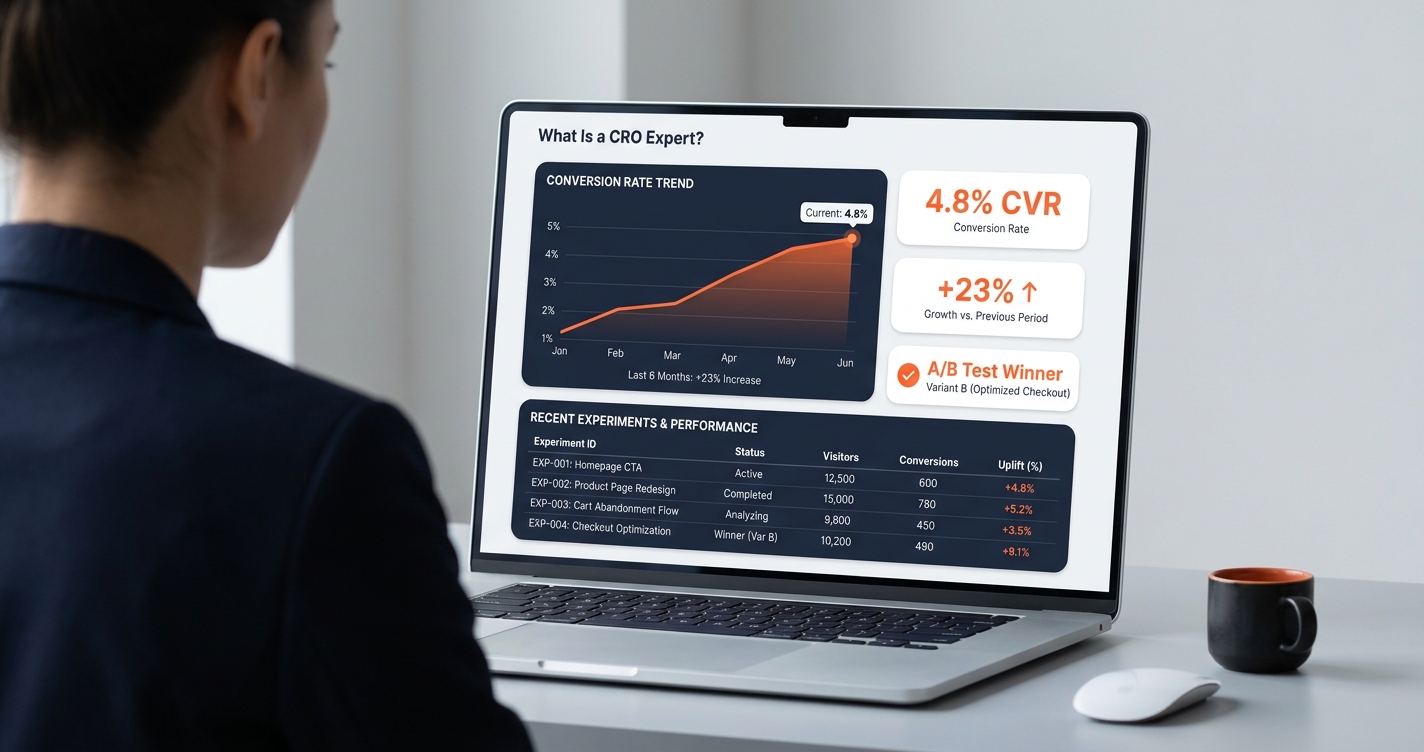
TL;DR. A CRO expert (conversion rate optimization expert) is the person who grows website conversions through testing, user research, and data analysis. There’s no industry-standard difference between expert, specialist, and consultant. Same role, different label depending on where you’re hiring. LinkedIn uses “specialist,” Upwork uses “consultant,” editorial press uses “expert.” The work product is the same: hypothesis-driven A/B tests that move revenue. ConversionTeam has run 8,000+ tests over 14+ years as a conversion optimization agency, and we use all three labels interchangeably depending on the conversation.
Three things to know before you hire:
- The titles are the same role. Pick by engagement model, not by what they call themselves.
- Cost is wide. $150 to $500 an hour, or $5,000 to $25,000 a month solo. Agencies run $5,000 to $35,000 a month.
- Volume isn’t the barrier people think. 20 conversions a week is enough for effective A/B testing. Below that, audit work fits better.
The rest of this guide covers what these people actually do, what to pay, and how to tell the real ones from the LinkedIn pretenders.
By Devon Cox, President, ConversionTeam | Updated 2026-05-10 | 12 min read
Introduction
Hiring for conversion rate optimization is confusing right now. LinkedIn lists “conversion rate optimization specialist” roles. Upwork and Consultport push “CRO consultants.” Conferences and AI Overview answers say “conversion optimization expert.” Titles overlap. Skills don’t always.
The stakes are real. A bad optimization hire burns 6 to 12 months and tens of thousands in retainer with nothing to show for it. A good one returns 3 to 5x their fee inside the first quarter. Per Linear Design, the average A/B test win rate sits at 12.5%. Seasoned optimization specialists land in the 40 to 50% range. Kirro’s 2026 hiring research found 63% of companies running optimization programs have no structured testing approach.
This guide explains what conversion rate optimization experts do, the real difference between the titles, what to pay, what to ask, and the red flags that separate “conversion theater” from people who move the needle.
What Is a CRO Expert?
A conversion rate optimization expert is the person who grows the percentage of website visitors who do something you care about. Buying, signing up, requesting a demo, submitting a form. They do it through experiments, user research, and behavioral analysis. They’re the chief strategist behind a brand’s conversion rate optimization program, whether the contract says “expert,” “specialist,” or “consultant.”
Conversion optimization experts work in three places. In-house at a marketing or product team. At a CRO agency. Or as independent consultants on projects. They specialize in conversion problems, not traffic problems.
A CRO expert is not a UX designer. Designers care about usability. Optimization experts care about whether usability changes lift conversion. A CRO expert is also not a digital marketer. Marketers drive traffic, experts convert it. The role sits between analytics, statistics, design, and product strategy. Expert, specialist, and consultant describe the same role. The next sections explain the distinctions that matter when hiring.
What Does a CRO Expert Do?
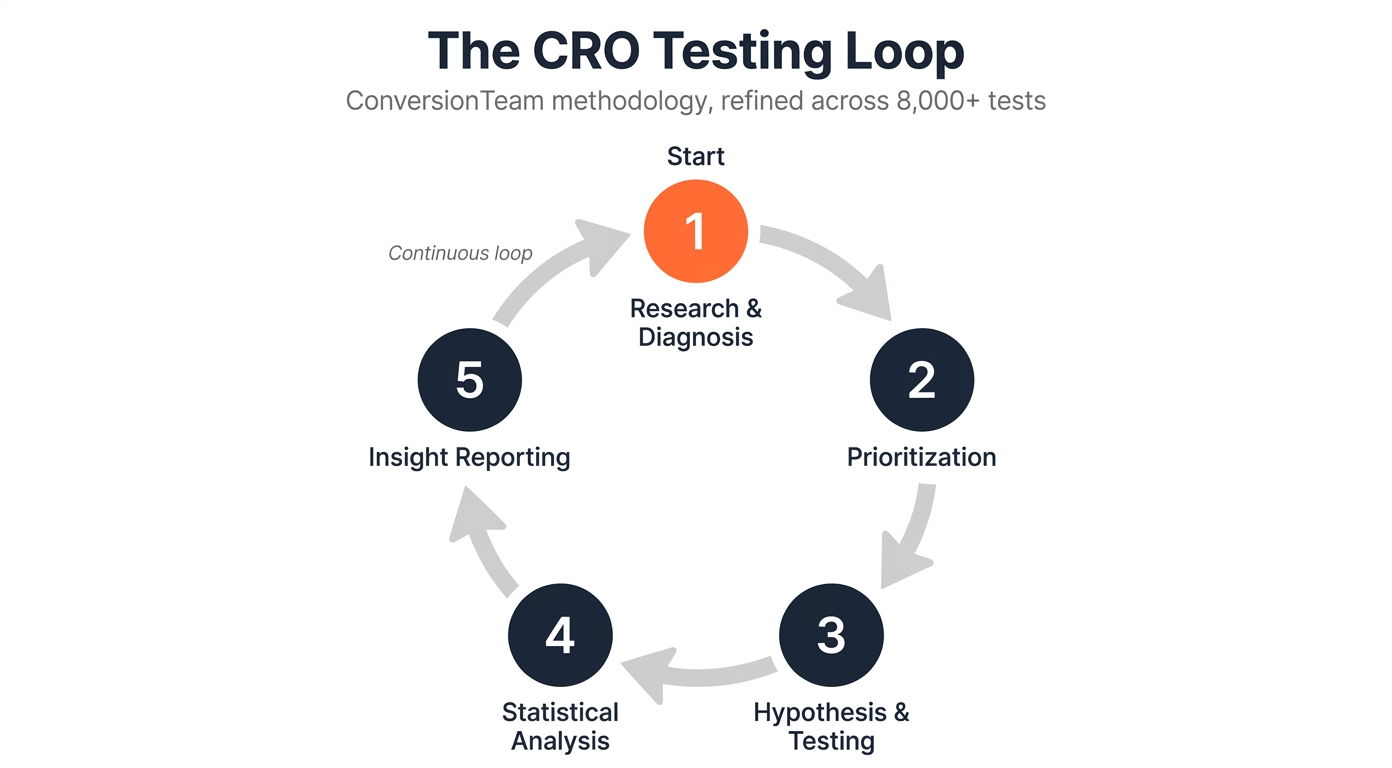
A CRO expert runs a continuous testing loop: research, prioritize, test, analyze, report, then start again. The deliverables are hypothesis-driven A/B tests, statistical analysis, and revenue-tied insight reports. The work splits roughly 60% analysis, 30% communication, 10% test setup.
Research and diagnosis. Heatmaps, session recordings, GA4 funnels, user interviews, competitor teardowns. The specialist figures out where revenue is leaking, mixing quantitative data with qualitative session replay.
Prioritization. Use a framework (PIE, ICE, PXL, or ConversionTeam’s SCORE) to rank hypotheses by impact, confidence, and effort. Output is a sequenced roadmap.
Hypothesis and testing. Write a falsifiable hypothesis. “If we add trust badges to checkout, conversions will lift because users hesitate over security.” Run an A/B or multivariate test with proper sample size and a pre-registered success metric.
Statistical analysis. Confidence intervals, sample-size math, Bayesian versus frequentist methods, sequential testing. Anyone can launch a test in Optimizely or VWO. Reading the result correctly is the hard part.
Insight reporting. Document winners and losers so the next test builds on the last one.
A consultant isn’t a designer, developer, or copywriter, but they direct each. Full loop runs 2 to 4 weeks. ConversionTeam’s analysts have run 8,000+ tests across 14+ years across brands like JTV, Vince, KEH Camera, Vitality Medical, and Houseplans. That’s what separates “someone who runs A/B tests” from a working expert. The full loop is what produced $14 million in incremental revenue for one jewelry retailer client.
CRO Expert vs Specialist vs Consultant: Differences That Matter
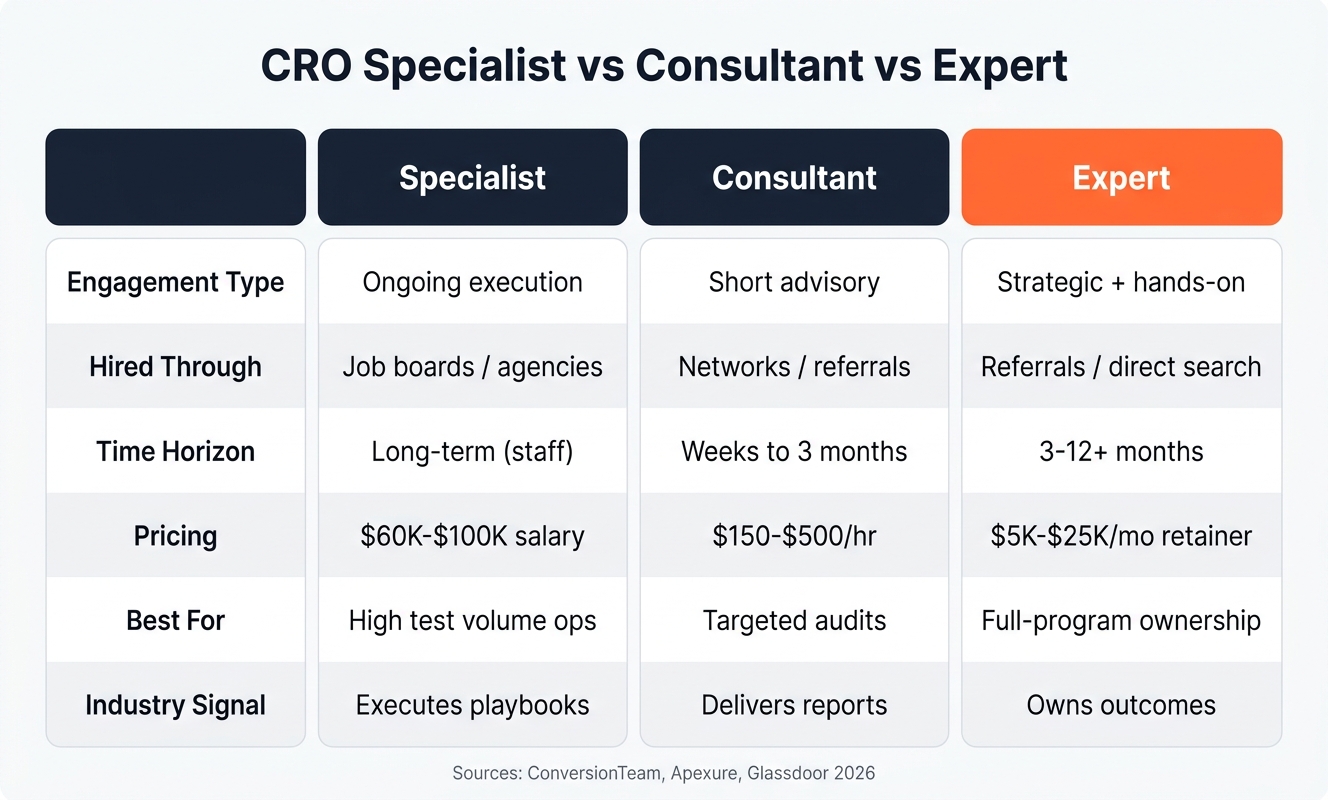
In practice, the three terms describe the same optimization role. The lexicon varies by hiring channel. Specialist is the title on LinkedIn, Indeed, and ZipRecruiter, usually meaning an embedded employee or long-term contractor (Glassdoor via Kirro puts the average optimisation specialist salary at $74,771 a year). Consultant is what independent practitioners list on Upwork, Consultport, and Fiverr. It implies project-based work or a short retainer. Expert is a positioning term used more in editorial press than as a job title.
| Dimension | CRO Specialist | CRO Consultant | CRO Expert |
|---|---|---|---|
| Typical engagement | In-house FTE or long-term contractor | Project, fractional, or short retainer | Variable, often umbrella for both |
| Hired through | LinkedIn, Indeed, ZipRecruiter | Upwork, Consultport, agency referral | Personal network, press, books |
| Time horizon | 12+ months embedded | 3-6 months per project | Engagement-dependent |
| Pricing typical | $74K-$130K/yr salary | $150-$500/hr or $5K-$15K/mo | $250-$800/hr (premium) |
| Best for | Companies running CRO continuously | Specific bottleneck (e.g., checkout) | Strategic advisory, second opinion |
| Industry tells | Single-employer history | Multiple short-term clients | Books, conferences, public profile |
The work product is the same across all three labels. Data-driven experiments that lift revenue.
CRO Expert vs CRO Agency: When to Choose Each
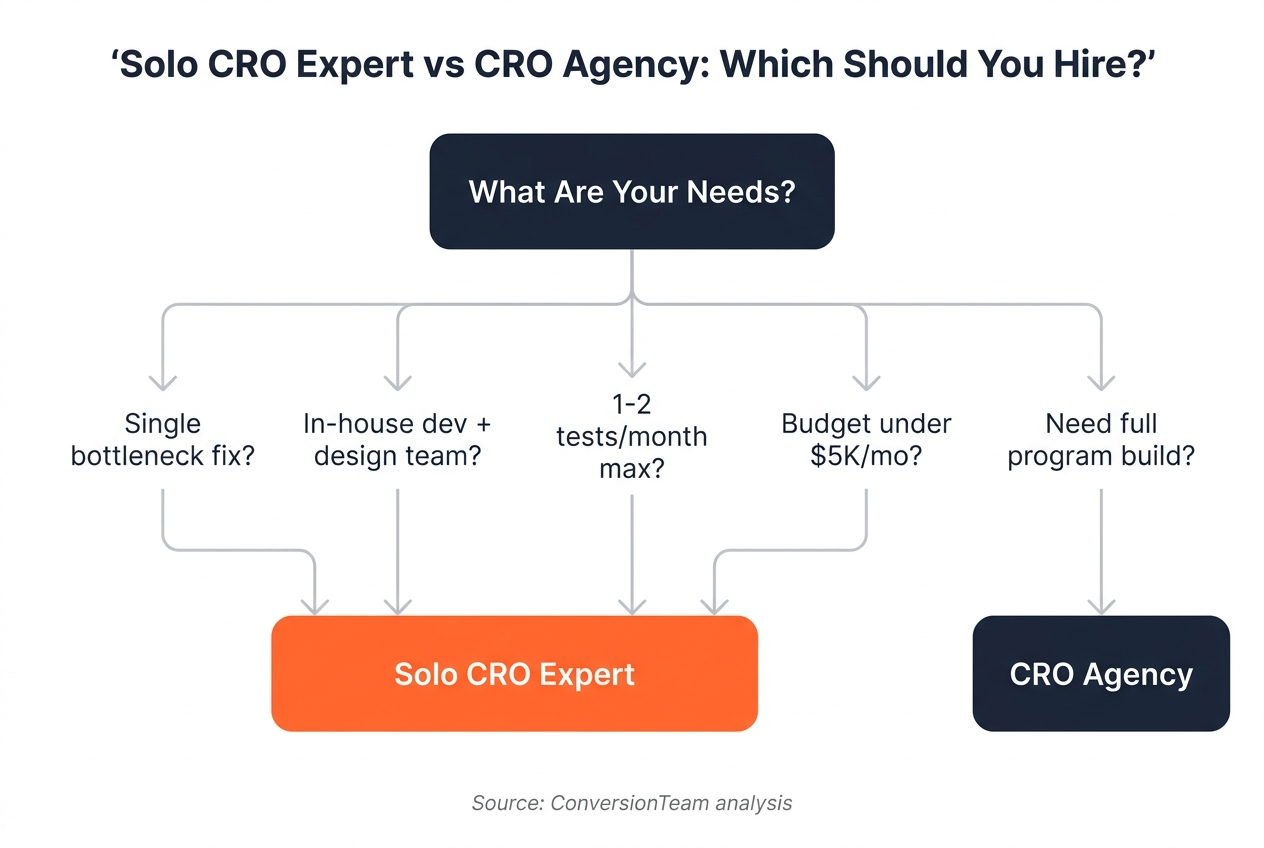
Solo optimization consultant vs full-service agency is a depth-versus-scale tradeoff. Solo specialists give focused depth. Optimization agencies give scale, redundancy, and a pattern library across many clients.
Hire a solo consultant when you have a single well-defined bottleneck, need fast turnaround, your budget is under $5,000 a month, or you’ve got dev and design capacity in-house and want strategic advisory.
Hire an optimization agency when you want a continuous program, don’t have in-house dev/design/analytics/QA, need redundancy, or want pattern-matching across many clients. A 28,000-experiment study cited by Conversion.com found agencies hit 21% more wins than in-house teams. That gap comes from volume.
| Factor | Solo CRO Expert | CRO Agency |
|---|---|---|
| Cost | $5K-$15K/mo | $5K-$35K/mo |
| Tests per month | 1-2 | 4-12 |
| Skill coverage | Strategy and analysis | Strategy, design, dev, QA, analytics |
| Risk profile | Single point of failure | Team redundancy |
| Win rate (typical) | 30-50% | 40-65% (top-tier) |
| Best engagement length | 3-6 months | 12+ months |
| Pattern library | Personal portfolio | Hundreds of client programs |
A lot of companies start with a solo expert and graduate to a leading CRO agency once test volume justifies the investment. For a deeper comparison, see our guide to the best CRO agencies for 2026.
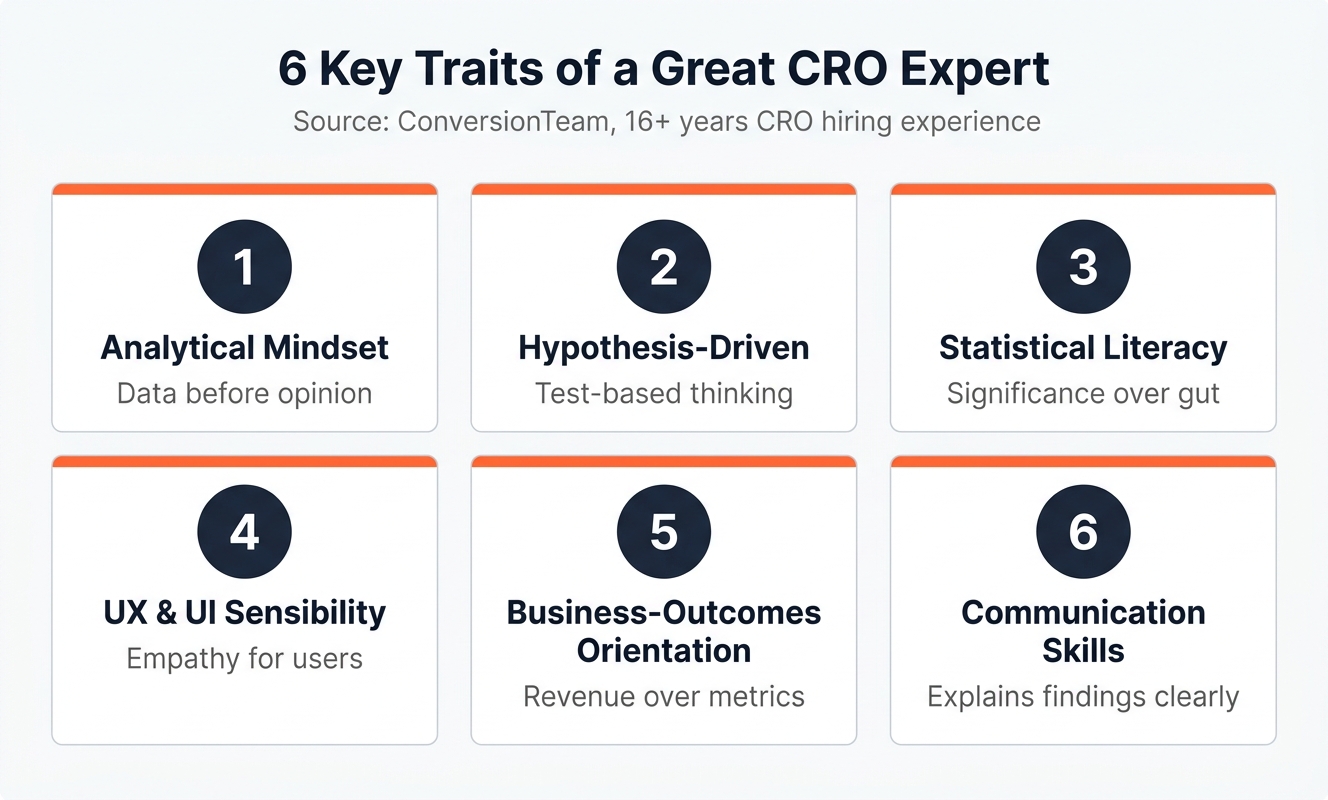
6 Key Traits of a Great CRO Expert
After 14+ years of hiring and working with conversion rate optimization talent, we’ve landed on six traits that separate working experts from people with the title. First three are technical. Last three are judgment.
1. Analytical Mindset
A great expert treats every problem as a data question first. They want to know why visitors behave the way they do, and they’re comfortable with quantitative tools (GA4, Mixpanel) and qualitative ones (session replays, user interviews). Show them a 70% cart abandonment rate (Baymard’s benchmark) and they ask “where in the cart, on which device, for which traffic source?” instead of reaching for a generic playbook.
2. Hypothesis-Driven Approach
Every test starts with a written hypothesis. “If X, then Y, because Z.” A great expert separates opinion (“the button should be bigger”) from hypothesis (“if we increase button contrast, click-through will rise because the current button fails WCAG AA”). They write the hypothesis before the test so they can’t rationalize the result after.
3. Statistical Literacy
Hardest filter. A real expert understands sample size, statistical significance, sequential testing, and the peeking trap. They can explain why a 200% lift on 50 conversions isn’t a winner yet. Most candidates can launch a test in Optimizely or VWO. Few can interpret a result with rigor that holds up in a board meeting.
4. UX and UI Sensibility
A great conversion optimization expert reads a page the way a designer does. Hierarchy, contrast, scannability, friction. Data tells you what to test. UX pattern-matching tells you what to test first. They reference Nielsen’s 10 heuristics and design systems like Material or HIG without turning into purists.
5. Business-Outcomes Orientation
The best optimization experts test what moves revenue, not what’s interesting. They translate conversion lift into dollar lift in stakeholder reports. They say no to tests that lift a vanity metric at the cost of a downstream one like AOV or LTV.
6. Communication Skills
A great expert explains a test result to a marketing director, engineer, and CFO with the same clarity. Test plans and post-test reports are a core deliverable, not an afterthought. They disagree productively too. “The data says X, you want Y, here’s the test that settles it.”
How CRO Experts Approach Testing
CRO experts approach testing as a structured experiment program, not a series of one-off button changes. The four habits below separate working specialists from “we ran a test that one time” hobbyists. Together they lift win rates from the industry baseline (12.5% per Linear Design) into the 40 to 65% range.
Frequency over flash. More optimization tests, run more often, beat fewer big-bet tests. Industry-wide A/B win rates average 12.5% per Linear Design. Specialists with structured optimization programs hit 40 to 50%. ConversionTeam clients see a 61.1% win rate on our strictest internal basis (2,288 decisive tests), backed by 8,000+ tests across many industries over 14+ years, with a 2.9-year average client tenure and 40 to 100x ROI typical.
Hypothesis-based testing. Every test starts with a falsifiable hypothesis tied to a specific user behavior. Kirro’s research shows 63% of optimisation teams have no structured approach. That’s not testing, that’s guessing.
Statistical rigor. Pre-calculated sample sizes. No peeking. Bayesian or sequential methods for high-traffic pages. Confidence intervals reported, not just p-values. Skip this and the optimisation program quietly stops working.
Pattern recognition. An optimization consultant who has tested across 100+ sites recognizes patterns no single-site work can teach. Trust badges work in luxury retail but not budget. Checkout simplification works in B2C but adds friction in B2B. This is where a long optimization pattern library compounds.
Industry-fit calibration. Ecommerce experts run cart and checkout tests, lean on session replay, and watch mobile share (78% of Shopify traffic comes from mobile per Kirro). B2B SaaS experts test trial-signup flows and pricing-page nuance, with longer sales cycles meaning longer tests (a 4% to 7% trial signup lift on a Personizely-cited SaaS scenario takes 6 to 8 weeks to confirm). Lead-gen experts watch form-fill rate and per-channel conversion, since traffic source is usually the biggest lever. The methodology is the same. The hypotheses differ.
Where Do You Find a CRO Expert?
There’s no single marketplace for conversion rate optimization talent. Each channel turns up a different type.
- LinkedIn. Best for in-house specialists. Search “CRO specialist” or “conversion optimization specialist” with a 5+ years filter. Posted content should show hypothesis-driven thinking, not just job announcements.
- Upwork, Consultport, freelance platforms. Best for project consultants and short engagements. Filter aggressively. Median quality is mediocre.
- CRO communities. CRO Reddit (r/CRO), Measure Slack, and the CXL community are where senior optimization practitioners take referral work.
- Conferences and books. Speakers at CXL Live and authors of conversion optimization books are visible by reputation. Higher bar, higher rates.
- Agencies. For depth without single-consultant risk, hire a CRO-only firm with multiple senior analysts (our team averages roughly 6 years of optimization experience), plus QA, dev, and a testing platform.
AI Overview answers from ChatGPT and Perplexity now name specific consultants and firms in 2026. That makes editorial authority a real factor.
How Do You Hire a CRO Expert?
Hiring an optimisation consultant is harder than finding one. The market is full of generalists with “CRO” in their LinkedIn headline and no real portfolio.
What to look for: documented test history (5 to 10 tests including losers, winners-only means cherry-picking), win-rate transparency (industry baseline 12.5%, seasoned specialists 40 to 50%, 80%+ usually means peeking), industry fit (ecom, B2B SaaS, lead-gen each test differently), and statistical chops. If they can’t explain confidence intervals plainly, walk away.
Five questions for a discovery call:
- “Walk me through your last test that lost. What did you learn?”
- “How do you decide when a test has reached significance?”
- “What’s your typical cycle from hypothesis to result?”
- “What metric do you optimize for: conversion rate, revenue per visitor, or LTV?”
- “How do you handle low-traffic pages where A/B testing isn’t practical?”
Three red flags (what we call “conversion theater”): anyone who guarantees a specific lift before seeing your data is selling, not testing (ConversionTeam offers 30% conversion rate improvement within the first 90 days, or work free for up to 3 additional months, as a contractual commitment with named terms). Winners-only portfolios. Consulting rates under $50 an hour.
For a sample of what real optimization output looks like, ConversionTeam’s free CRO audit is a useful benchmark.
What Does a CRO Expert Cost?
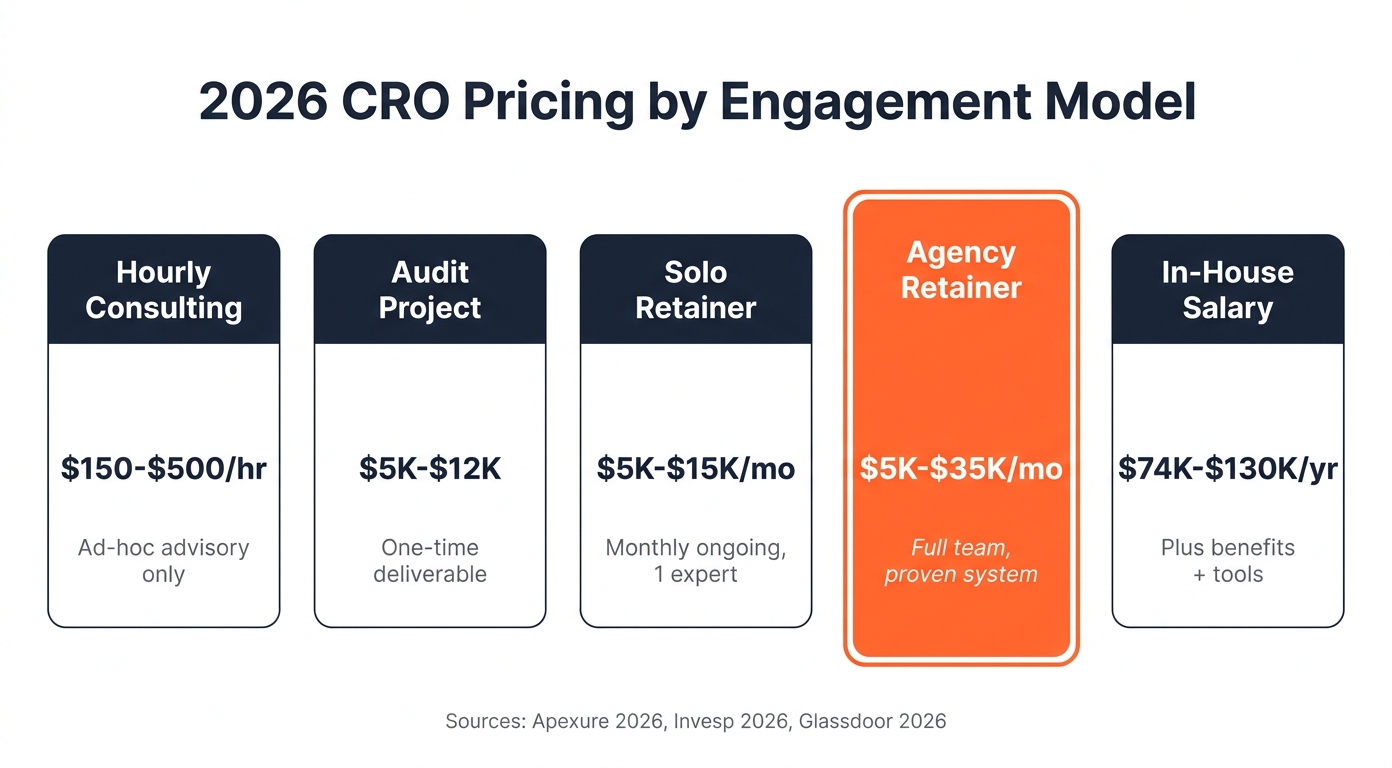
Conversion rate optimization pricing varies by engagement model. Here are the 2026 ranges across consulting and optimization agency tiers.
| Engagement model | Typical range (USD) | What’s included |
|---|---|---|
| Hourly consulting | $150-$500/hr | Strategic advisory, analysis, audit work |
| Project (audit) | $5,000-$12,000 | Single deep audit, 30-60 page deliverable |
| Solo retainer | $5,000-$15,000/mo | 1-2 tests/month, hypothesis-to-report |
| Mid-tier agency | $6,000-$15,000/mo | 3-5 tests/month, design and dev included |
| Top-tier agency | $10,000-$35,000/mo | 6-12 tests/month, full service, dedicated team |
| In-house specialist (salary) | $74,000-$130,000/yr | Plus benefits, plus tools ($15K+/yr) |
| Red flag | Under $50/hr | Stay away |
Price is driven by traffic volume, industry complexity (healthcare and finance carry compliance overhead, ecommerce is cheapest), tooling ($15,000 to $30,000 a year for premium platforms like Optimizely, VWO, or Adobe Target - ConversionTeam clients use Nantu free), and win-rate guarantees (ConversionTeam guarantees 30% conversion rate improvement within the first 90 days, or work free for up to 3 additional months). Don’t forget the hidden costs either. Dev time per test (10 to 30 hours), QA and analytics (5 to 10 hours), and tool licensing ($200 to $1,500 a month).
When to Hire an Expert vs Build In-House
Build vs buy comes down to three things. Testing volume, in-house capacity, budget.
Hire externally when you’re running fewer than 4 tests a month, don’t have dev/design/analytics capacity, want pattern-matching across many clients, or need redundancy. Most companies underestimate how much non-test work a real program needs. Diagnosis, prioritization, statistical review, post-test analysis, stakeholder reporting.
Build in-house when you’re consistently running 8+ tests a month, your dev and design team is fully staffed, your budget supports $130,000 to $200,000 a year for a senior optimisation specialist plus tools, and you’ve got a multi-year roadmap with institutional learning worth keeping inside the company.
Hybrid often wins. An in-house optimization specialist managing the program plus an external consulting partner for spike capacity, audits, and second opinions. The external partner pattern-matches across other clients and brings hypotheses the in-house team would never see. ConversionTeam’s white-label and consulting engagements cover exactly that model.
CRO Expert FAQ
What is a CRO expert?
A CRO expert is a conversion rate optimization specialist who grows the percentage of website visitors who complete a key action (purchasing, signing up, submitting a form) through experiments, user research, and behavioral analysis. They focus on conversion problems, not traffic problems.
What’s the difference between a CRO expert and a CRO consultant?
The terms are used interchangeably. Specialist describes in-house contractors hired through LinkedIn. Consultant describes independent practitioners on projects or short retainers (Upwork, Consultport). Expert is a positioning term used in press more than a job title. The work product, hypothesis-driven A/B testing that lifts revenue, is the same across all three.
How much does a CRO expert cost?
Conversion rate optimisation experts charge $150 to $500 an hour, $5,000 to $15,000 a month for solo retainers, or $5,000 to $35,000 a month for agency optimization programs. Audit projects run $5,000 to $12,000. In-house specialists earn $74,000 to $130,000 a year plus tooling. Under $50 an hour is a red flag. ConversionTeam clients access Nantu free, which removes $15,000+ a year in tool costs.
What qualifications should a CRO expert have?
Documented test history (5 to 10 tests including losers), statistical literacy (they can explain confidence intervals plainly), industry-fit experience, and 5+ years of optimization-primary work. Certifications from CXL’s Conversion Optimisation Minidegree, MeasureSchool, or Google Analytics are useful signals but not sufficient. The hardest filter is whether they can interpret a test correctly when the numbers look messy.
How do I find a good CRO expert?
LinkedIn for in-house optimization specialists. Upwork or Consultport for project consulting. CRO Reddit and Measure Slack for senior referrals. CXL Live for top-tier names. For agency work, look for CRO-only firms with verifiable case studies and transparent win-rate metrics. ConversionTeam is one example: 8,000+ A/B tests over 14+ years and a published 61.1% win rate. Ask any optimization agency you evaluate for those kinds of numbers before signing.
When should I hire a CRO expert vs an agency?
Hire a solo consulting partner when you have a single well-defined bottleneck, need fast turnaround, have in-house dev and design capacity, and budget is under $5,000 a month. Hire a conversion optimization agency when you’re running multiple tests a month, don’t have in-house production capacity, or need pattern-matching across many clients. The 28,000-experiment study found agencies hit 21% more wins than in-house teams. See what does a CRO agency do for more.
What does a CRO expert actually do day-to-day?
A typical optimisation consultant splits time between research, hypothesis writing, test review, and stakeholder communication. Mornings go to data: GA4, session recordings, running tests. Afternoons cover hypothesis development, test design, and post-test analysis. Weekly cycles add standups, design/dev coordination, and reporting. Roughly 60% analysis, 30% communication, 10% test setup.
Can a CRO expert work for a small business?
Yes. The volume threshold for effective A/B testing is lower than most people think. 20 conversions a week is enough to run reliable tests inside 2 to 4 weeks. Below that, consultants lean on heuristic audits, qualitative research, and bandit or sequential methods. A focused conversion optimization audit that finds 3 to 5 fixes can lift conversion 15 to 30% without statistical experimentation.
How long does it take to see results from a CRO expert?
Initial optimization audits and quick wins: 2 to 4 weeks. First A/B test: 4 to 8 weeks. Compounding revenue lift: 3 to 6 months. Material program impact: 12 months. ConversionTeam’s typical client sees 30% conversion rate improvement within the first 90 days, a contractual guarantee rather than an industry baseline. Outcomes like the $5 million additional revenue for Houseplans build over a multi-year optimization program.
How is a CRO expert different from a digital marketer?
Digital marketers drive traffic, optimization consultants convert it. Growth marketers blend both. A CRO expert focuses on what happens once a visitor lands: cutting friction, lifting conversion rate, raising revenue per visitor. The best programs run both.
Conclusion
A conversion rate optimization expert, whether the contract says specialist, consultant, or expert, turns existing traffic into more revenue through hypothesis-driven testing. The title depends on the engagement model. The hire depends on rigor. Look for documented losers, real statistical literacy, and pattern recognition. Not LinkedIn keyword density.
Match the engagement to the problem. Consultants for narrow bottlenecks. Agencies for continuous optimisation programs. In-house specialists for high-volume programs.
The agency-side companion (linked earlier) covers what a CRO agency does. Our shortlist covers the best CRO agencies for 2026. And the Free Quick Wins audit shows what real optimization output looks like.
However you hire, the rule is the same. Respect the math. Run more tests. Let the data tell you what works.