
Client background
An online gift-card marketplace worked with ConversionTeam to test how shoppers found, selected and purchased gift cards. This study covers the 21 A/B experiments on that marketplace included in its November 2024 progress report. Their recorded dates run from February 1 through October 28, 2024.
This is a defined reporting period within a longer engagement. It is not a full calendar-year result or a summary of every experiment the client ever ran.
The challenge
Gift-card shoppers make several choices before purchasing: which card to buy, how to send it, and whether to sign in or create an account. The program tested how the site's messages and controls affected those choices and the resulting purchases.
Objectives
- Test purchase paths across product pages, navigation and checkout.
- Explain account benefits where shoppers encounter registration and sign-in choices.
- Measure transactions and reported revenue against the users exposed to each version.
- Keep unsuccessful experiments and implementation decisions in the program results.
Our solution
We compared specific variations with the existing experience, reviewed purchase outcomes, and tested followup versions where the team chose to revisit an idea. The full program included checkout changes, product-page choices, registration prompts and homepage content.
Purchase conversion in this study means recorded transactions divided by exposed users. It is not a count of distinct people who purchased. Reported revenue per user is a separate measure, calculated for each version's own audience.
Program highlights
- Checkout headers, sign-in prompts and registration messages.
- Product-page choices, recipient information and delivery defaults.
- Homepage messages, reviews and navigation.
- Gift-buying prompts shown to recipients.
The three featured examples were selected after reviewing the program results and available comparisons. Each had a positive reported revenue-per-user comparison. That selection does not mean every winning experiment increased revenue per user. The full table includes contrary results.
Featured experiment 1 of 3
Move sign-in into a simpler checkout header
Background and hypothesis
The existing checkout retained navigation and search, while the sign-in prompt sat in the form below. We tested a simpler header with sign-in at the top. The hypothesis was that shoppers could find the relevant account action while keeping their attention on checkout.
What visitors saw
The selected variation removed the extra navigation and search from the checkout header and moved the existing-account sign-in prompt into it. In the mobile captures, the shipping form follows beneath the heading and cart link.
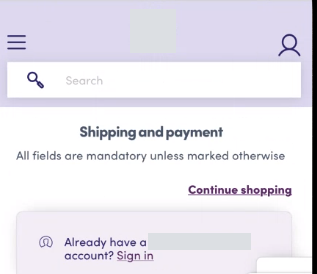
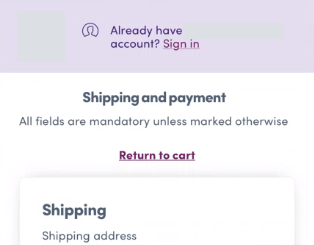
Authentic mobile crops with identifying details masked. The results below cover the overall experiment; they are not a mobile-only result.
Results
Purchase conversion rose from 66.83% to 70.13%, a 4.9% relative increase. Reported revenue per user rose 18%. The selected variation received a winning decision.
The revenue-per-user comparison accounts for unequal exposure between versions. Its statistical confidence was not reported, so it should be read as an observed comparison. The test did not separately measure whether reduced distraction caused the change.
Featured experiment 2 of 3
Explain account benefits at the desktop Sign In link
Background and hypothesis
The control displayed a plain Sign In link in the header. We tested whether explaining the benefits of an account at that point would help shoppers decide whether to create an account or sign in.
What visitors saw
Hovering over Sign In opened a panel that described stored payments, order status and history, early access and promotions, and reward points. It offered “Register now” and “Sign in” buttons. This was a desktop intervention.

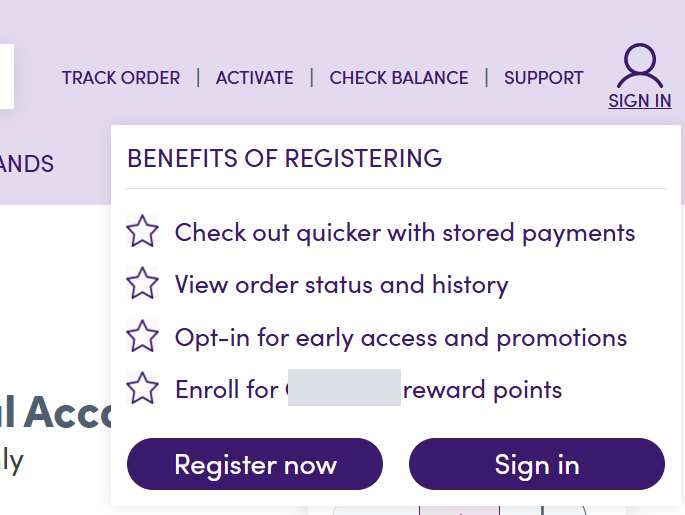
Authentic desktop crops. Gray masks hide identifying content. The reported statistics come from the overall experiment dashboard, not a newly selected device subset.
Results
Purchase conversion rose from 6.78% to 6.97%, a 2.8% relative increase. Reported revenue per user rose 12%. The program recorded a winning decision for the variation.
A small purchase-rate change can affect the number of transactions across a substantial audience. Here, the measured result concerns purchases and revenue per user; it does not establish that registrations increased. Revenue-per-user confidence was not reported.
Featured experiment 3 of 3
Give gift recipients a simpler gift-buying prompt
Background and hypothesis
The recipient page invited visitors to “return the favor” and displayed five card or store choices. We tested a revised prompt with fewer initial choices and a clear route to browse other eGifts.
What visitors saw
The selected variation led with “Send a gift card,” revised the supporting copy, and showed two multi-brand card choices plus Shop all eGifts. This was one variation in a test that also explored other treatments.


Authentic desktop crops at different original sizes. Identifying details are masked. These results cover the overall experiment, not a desktop-only subgroup.
Results
Purchase conversion rose from 5.88% to 6.03%, an observed 2.5% relative increase. Reported revenue per user rose 22%. The program selected this variation as a winner, with substantial uncertainty around the purchase-conversion estimate.
The conservative conversion estimate was zero. The reported revenue-per-user comparison had no quantified confidence and cannot inherit the conversion result's confidence. This is a selected program decision with an uncertain estimate, not proof of a dependable increase.
Full program results
The 21 included experiments produced 11 recorded winning decisions and ten nonwins. Separate iterations count as experiments; extra variations within one experiment do not. The count includes every eligible experiment on the marketplace in this reporting period, regardless of outcome.
Tests on a separate site and an A/A quality check are outside this study's scope. The A/A check compared equivalent experiences to check measurement, so it is not an optimization A/B experiment.
| Experiment | Recorded outcome | Result and context |
|---|---|---|
| Valentine's countdown | Winning decision | Purchase conversion +1.9%; revenue per user -3%. The conversion estimate was uncertain. |
| Product-page alternative shopping links | Winning decision | Purchase conversion +6.6%. |
| Homepage experience | Nonwin | Purchase conversion -2.8%. |
| Product-page followup | Winning decision | Purchase conversion +2.9%; permanent implementation was not confirmed. |
| Homepage quadrant links | Nonwin | Purchase conversion -4.6%. |
| Social-login followup | Winning decision on mobile | The recorded winner applied to mobile only. The implementation was later turned off. |
| Gift-buying prompt for recipients | Winning decision | Selected variation: purchase conversion +2.5%, with an uncertain estimate. Featured above. |
| Checkout-header simplification, first experiment | Nonwin | The recorded outcome was a nonwin. The later dashboard had measurement-label errors, so no numerical comparison is presented here. |
| Homepage promotional band | Nonwin | Purchase conversion +0.2%, a near-flat result. |
| Product-page rewards message | Nonwin | Purchase conversion -2.5%. The change was implemented despite the nonwin decision. |
| Registration benefits at desktop sign-in | Winning decision | Purchase conversion +2.8%. Featured above. |
| Homepage rewards message | Winning decision | Purchase conversion +0.6%. |
| Checkout header with sign-in prompt | Winning decision | Purchase conversion +4.9%. Featured above. |
| Gift-card navigation dropdown | Winning decision | Reported purchase conversion +5.0%; tracking and traffic-distribution concerns limit interpretation. |
| Homepage reviews | Winning decision | Selected variation: purchase conversion +2.0%; revenue per user -11%. The conversion estimate was uncertain. |
| Checkout review widget | Nonwin | Purchase conversion -1.4%. |
| Default to text delivery on product pages | Winning decision | Purchase conversion +2.2%; revenue per user -6%. The winner decision did not include virtual implementation. |
| Top-navigation overlay | Nonwin | Purchase conversion -5.4%. Deployment status was unresolved. |
| Recipient and message fields on product pages | Nonwin | Purchase conversion -5.0%. |
| Persistent subnavigation | Nonwin | Purchase conversion -1.1%. |
| Checkout registration popup | Nonwin | Purchase conversion -5.5%. |
A recorded win does not mean every metric improved or that the change stayed live permanently. Three recorded wins in this table had lower revenue per user. One nonwin was implemented. Those decisions remain part of the program account.
The experiment percentages are separate comparisons. This study does not add them into a combined conversion lift or convert them into an annual revenue or ROI claim.
Measurement appendix
The source defines users by unique analytics identifiers and purchase conversion as transactions per user. Multiple transactions count under the original method. The results do not substitute a distinct-purchaser rate. All lifts are relative changes, not percentage-point changes.
| Experiment | Control transactions / users | Selected variation transactions / users | Reported conversion confidence | Conservative conversion lift |
|---|---|---|---|---|
| Checkout sign-in header | 9,856 / 14,748 | 10,585 / 15,093 | 100%, rounded by the source | 4.4% |
| Desktop registration benefits | 5,080 / 74,940 | 5,218 / 74,911 | 92% | 1.4% |
| Recipient gift-buying prompt | 998 / 16,970 | 1,030 / 17,080 | 72% | 0.0% |
- The source's rounded 100% conversion confidence is not literal certainty.
- The recipient-prompt result describes the selected second variation, not the other variations explored in that experiment.
- Revenue per user compares each version's reported revenue with its own exposed-user count; no confidence estimate for that measure was supplied.
- Reported revenue is not profit, recognized accounting revenue or an annual incremental-revenue forecast.
- The countdown and homepage-reviews winners had 75% and 79% reported conversion confidence respectively, alongside the negative revenue-per-user comparisons shown above.
Program counts describe recorded decisions within this defined set. They do not create a new significance threshold, imply independent hypothesis groups, or measure a financial-services industry success rate.
Frequently asked questions
What period does this program study cover?
It covers the marketplace A/B experiments included in the November 2024 progress report. Their recorded dates run from February 1 through October 28, 2024. It is not the full calendar year or the entire longer engagement.
How were the 21 experiments counted?
Each distinct marketplace A/B experiment counts once, including followup iterations and nonwins. Additional variations do not add experiments. Tests on a separate site and an A/A measurement check are outside this case's scope.
What does purchase conversion mean here?
It means recorded transactions divided by exposed users, as defined by the original dashboards. It is not the percentage of distinct people who purchased.
Did all 11 winning decisions increase revenue per user?
No. The full results show winning decisions with negative revenue-per-user comparisons. The three featured examples were selected after reviewing the results and should not be treated as the whole program.
Were all winning changes permanently implemented?
No. Some implementation decisions differed from the recorded test outcome, and one mobile-only winner was later turned off. A recorded winning decision is not proof of permanent deployment.
Can the lifts be added into a program revenue result?
No. These experiments tested different changes and audiences. This study reports their individual comparisons and complete program decisions without summing lifts or claiming annual revenue or ROI.
Review your purchase flow
Read about our financial-services conversion rate optimization work, or see how the credit-union testing program handled application starts and completions.
Compare CRO programs and pricing for the research and testing your team needs.